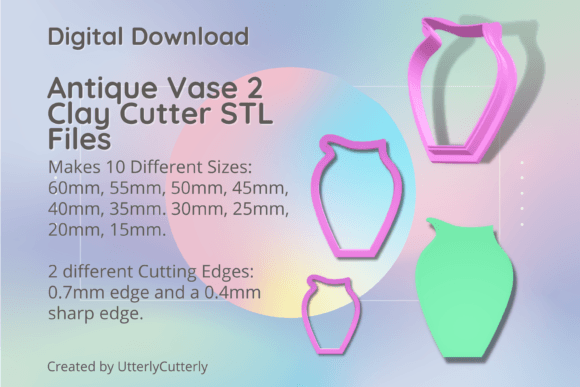
Organic Vase 1 Clay Cutter - STL Digital: Technical Specifications and Practical Applications
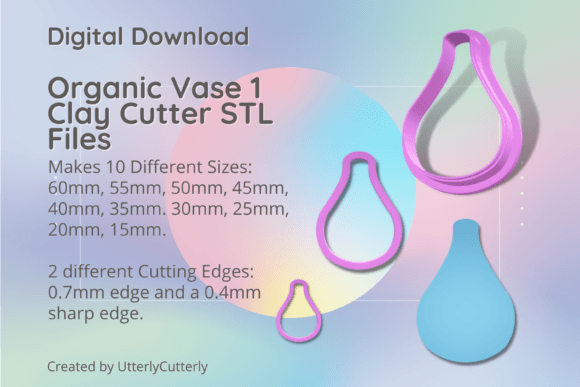
The Organic Vase 1 Clay Cutter - STL Digital represents a specific category of digital fabrication assets designed for polymer clay artists, ceramicists, and cookie decorators who utilize 3D printing technology. Unlike mass-produced metal cutters or generic plastic shapes found in craft stores, this digital download provides the source files necessary to manufacture custom tools tailored to precise dimensional requirements. The primary distinction of this asset is its focus on organic, fluid geometry rather than rigid symmetry, combined with a comprehensive sizing matrix that allows for graduated design work.
When evaluating digital cutter files against physical alternatives or other STL packs, the value proposition lies in versatility and printability. This specific bundle includes ten distinct sizes ranging from 15mm to 60mm and offers two specialized cutting edge profiles. For makers comparing options, understanding the technical differences between these profiles and the intended material thickness is essential for determining if this digital asset aligns with current project needs. The files are engineered for FDM (Fused Deposition Modeling) printers, prioritizing structural integrity during the printing process to ensure the final tool performs reliably without warping or layer separation.
Evaluating Cutting Edge Profiles: Standard vs. Sharp Edge Variants
A critical decision factor when selecting an STL file for clay cutting is the blade geometry. Not all clays respond identically to the same edge thickness, and having multiple options within a single pack addresses this variability. The Organic Vase 1 Clay Cutter - STL Digital includes two distinct cutter types, each serving different functional purposes.
The Standard 0.7mm Wall Profile
The standard version features a 0.7mm wall thickness with a 3mm thick base and a total height of 12mm. This profile is generally considered the workhorse option for most polymer clay applications. The 0.7mm edge provides a balance between cutting efficiency and durability. Thinner edges on 3D printed tools can sometimes be prone to snapping if excessive pressure is applied or if the print orientation does not align with the stress vectors. This standard profile is robust enough for firmer clays like Sculpey III or Cernit while still providing a clean release.
The 3mm base serves a dual purpose: it ensures adequate bed adhesion during printing, reducing the risk of failed prints on small footprints, and it provides a comfortable grip surface for the user. When comparing this to commercial plastic cutters, which often have uniform thin walls throughout, the reinforced base adds necessary rigidity without adding unnecessary bulk to the cutting area.
The Sharp Edge (SE) Variant
Abbreviated as "SE" in the file naming convention, the Sharp Edge variant utilizes a 1mm support wall tapering to a 0.4mm cutting edge. Like the standard version, it maintains a 3mm base and 12mm height. This profile is specifically engineered for softer materials or applications requiring minimal displacement. When working with soft porcelain, fondant, or very conditioned polymer clay, a thicker edge can drag or distort the material before severing it. The 0.4mm tip reduces this friction significantly.
However, users must weigh the tradeoffs. A 0.4mm printed edge is inherently more delicate than a 0.7mm edge. While it offers superior finish quality on soft media, it may require more careful handling and storage. Makers who primarily work with firm clays or apply heavy hand pressure may find the SE variant wears down faster than the standard profile. Conversely, those focusing on delicate jewelry components or edible decorations will likely prefer the SE variant despite its fragility.
Dimensional Versatility and Graduated Sizing
One of the significant limitations of purchasing physical cutters is the lack of consistent scaling. Finding organic vase shapes in perfectly graduated increments is rarely possible with off-the-shelf products. This digital bundle addresses that gap by providing ten sizes measured at 5mm intervals: 60mm, 55mm, 50mm, 45mm, 40mm, 35mm, 30mm, 25mm, 20mm, and 15mm.
This systematic sizing is particularly relevant for creators producing collections rather than individual pieces. For example, a jewelry maker designing a nested pendant set can utilize the 40mm, 30mm, and 20mm cutters to create visually harmonious proportions. Similarly, cookie decorators creating tiered displays benefit from predictable size reductions. When comparing this digital approach to buying individual physical cutters, the cost-per-size ratio is substantially lower, and the design language remains consistent across the entire range.
It is important to note that cutter size is measured from the longest ends of the organic shape. Because organic forms are irregular, the actual bounding box may differ slightly from the stated measurement depending on the axis. Users should verify dimensions in their slicer software before printing to ensure compatibility with specific project constraints.
Embossing Line Considerations
For designs featuring internal embossing lines, the relief height is set at 10.5mm. This specification dictates material requirements: the clay must be thicker than 1.5mm to accommodate the embosser without bottoming out. If working with sheets rolled thinner than 1.5mm, the embossing detail may punch through or fail to register clearly. This technical constraint distinguishes professional-grade STL files from amateur designs that often overlook material volume. Makers planning to use these cutters for thin veneer work should test print a single size first to validate compatibility with their preferred rolling thickness.
Digital Assets vs. Physical Tools: Decision Factors
Choosing between downloading the Organic Vase 1 Clay Cutter - STL Digital and purchasing a physical alternative depends on several practical variables including equipment access, timeline, and customization needs.
When Digital STL Files Are the Superior Choice
- Customization Needs: If your project requires specific sizes not available commercially, digital files allow you to scale or modify designs in CAD software before printing.
- Cost Efficiency at Scale: For makers needing multiple sizes or frequent replacements, the marginal cost of printing additional cutters is negligible compared to purchasing individual metal or plastic tools.
- Design Consistency: Access to a coordinated bundle ensures all tools share the same aesthetic lineage, which is difficult to achieve when sourcing physical cutters from disparate manufacturers.
- Immediate Access: As a digital download, files are available instantly after payment, eliminating shipping delays for time-sensitive projects.
When Physical Alternatives May Be Preferable
- No 3D Printing Infrastructure: Without access to an FDM printer and basic slicing knowledge, digital files have no utility. Outsourcing printing services often negates the cost advantage.
- Material Durability Requirements: Metal cutters remain sharper longer and can withstand higher temperatures. Printed PLA or PETG tools have thermal limits and will dull with extensive use on abrasive clays.
- Food Safety Certification: While many makers use printed cutters for cookies, 3D printed plastics are not universally food-safe certified due to layer lines harboring bacteria. Professional bakeries requiring compliance may need stainless steel alternatives.
- Immediate Tactile Evaluation: Digital files cannot be physically inspected before purchase. Makers uncertain about ergonomic comfort or edge quality may prefer holding a physical sample first.
Printability and Quality Assurance
A common frustration with free or low-cost STL files is poor optimization for additive manufacturing. Files with insufficient wall thickness, unsupported overhangs, or non-manifold geometry result in failed prints and wasted filament. The Organic Vase 1 Clay Cutter - STL Digital is explicitly tested for printability before release. The 3mm base thickness and 12mm height are not arbitrary; they represent validated parameters that promote successful first-layer adhesion and vertical stability.
Users should still apply standard best practices when printing these files. Orienting the cutter with the cutting edge facing up typically produces the sharpest result, though it may require supports for the internal embossing features. Alternatively, printing with the base down eliminates support requirements but may result in a slightly less defined cutting edge due to the elephant foot effect. Experimentation with orientation and cooling settings is recommended to optimize results for specific printer models and filament types.
New STL files are added to the store weekly, allowing makers to expand their toolkit incrementally. This ongoing development model contrasts with static physical product lines, offering continuous access to fresh designs. For makers building a comprehensive cutter library, this ecosystem approach enables long-term curation of compatible tools. However, users should assess whether the current bundle meets immediate needs independently of future releases, as digital assets are typically non-refundable once downloaded.
Ultimately, the Organic Vase 1 Clay Cutter - STL Digital serves makers who value precision, gradation, and self-sufficiency over convenience. It bridges the gap between digital design flexibility and tactile crafting requirements, provided users have the infrastructure and technical understanding to leverage its specifications effectively. By carefully considering edge profiles, dimensional ranges, and material compatibility, artisans can determine whether this digital resource aligns with their production workflow and creative objectives.