Arch 33 Clay Cutter - STL Digital File D: Technical Specs and Practical Applications
The Arch 33 Clay Cutter - STL Digital File D represents a specific category of digital fabrication assets designed for polymer clay artists, ceramicists, and cookie decorators who require precise geometric consistency. Unlike physical tools that are shipped with fixed tolerances, this digital download provides the source files necessary to manufacture a comprehensive suite of arch-shaped cutters locally. The distinct value of this specific STL bundle lies in its dual-edge engineering and granular sizing increments, which address common limitations found in standard single-profile cutters. For makers evaluating whether to add this file to their library, understanding the technical specifications and printing requirements is essential for determining if it aligns with current production workflows.
Dual-Edge Engineering and Structural Integrity
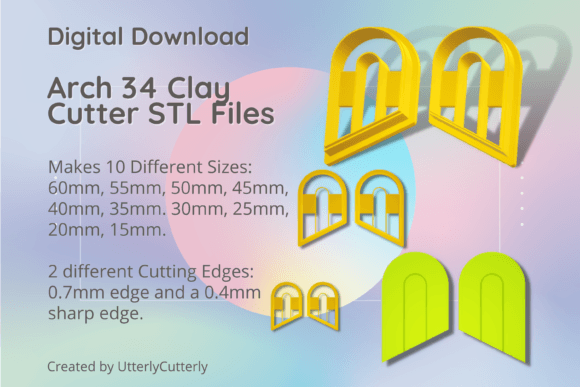
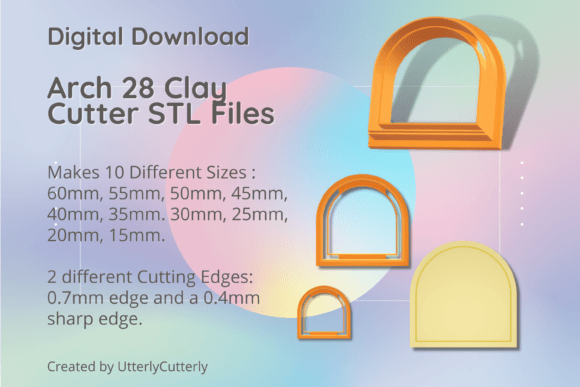
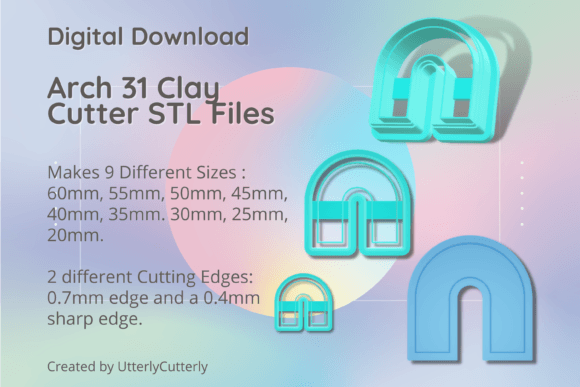
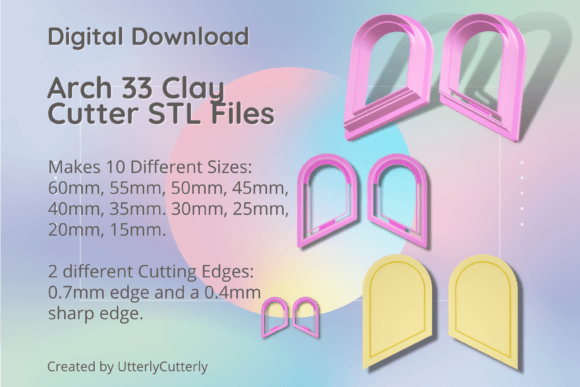
A primary differentiator for the Arch 33 Clay Cutter - STL Digital File D is the inclusion of two distinct cutting edge profiles within the same size set. Most digital cutter files offer only one variation, forcing users to choose between durability and sharpness before downloading. This bundle mitigates that tradeoff by providing both options for every size.
- Standard Edge: Features a 0.7mm wall thickness with a 3mm thick base and a total height of 12mm. This profile prioritizes structural rigidity and longevity. It is generally better suited for firmer clays or repetitive production where tool deformation must be minimized.
- Sharp Edge (SE): Abbreviated as SE in the file naming convention, this variant utilizes a 1mm support wall tapering to a 0.4mm cutting edge. Like the standard version, it maintains a 3mm base and 12mm height. The reduced contact surface area allows for cleaner cuts in soft materials with less drag, though it may require more careful handling during post-processing.
This duality allows users to print test pieces in both configurations to evaluate performance against their specific material viscosity. For example, a jeweler working with translucent polymer clay might prefer the SE variant to reduce surface distortion, while a cookie decorator working with stiff gingerbread dough may find the 0.7mm wall provides the necessary leverage without bending.
Sizing Granularity and Design Versatility
Precision in scale is often the deciding factor when selecting digital cutter files. Generic arch sets frequently utilize 10mm or even 15mm increments between sizes, which can leave gaps in design capabilities for detailed work. The Arch 33 Clay Cutter - STL Digital File D addresses this through a high-density sizing matrix ranging from 15mm to 60mm.
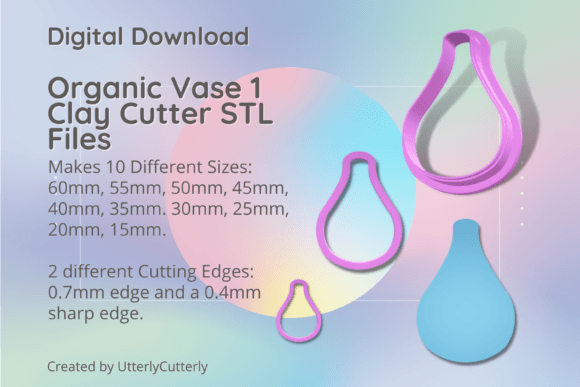
The available sizes are: 60mm, 55mm, 50mm, 45mm, 40mm, 35mm, 30mm, 25mm, 20mm, and 15mm. These measurements refer to the longest ends of the arch shape. The consistent 5mm step-down between sizes facilitates nesting designs and creating graduated patterns that are visually harmonious. This level of granularity is particularly relevant for earring makers who need to create cohesive collections with subtle size variations, or for mixed-media artists layering clay components where exact proportional relationships matter.
Embossing Compatibility and Material Thickness
Users intending to use these cutters for embossing rather than simple outline cutting must account for specific vertical tolerances. If the Arch 33 Clay Cutter - STL Digital File D includes embossing lines, they are modeled at a height of 10.5mm. Given the total cutter height of 12mm, this leaves a 1.5mm clearance zone.
Consequently, this tool set is engineered for clay sheets thicker than 1.5mm. Attempting to emboss thinner gauges may result in incomplete impressions or the cutter bottoming out before the design transfers fully. Makers working exclusively with paper-thin veneers or skinner blends under 1mm should verify compatibility or consider alternative files with shallower relief depths. For standard jewelry bases, coaster blanks, and cookie applications, however, this depth specification ensures robust impression transfer.
Printability and Manufacturing Considerations
Digital files are only as useful as their printability. The Arch 33 Clay Cutter - STL Digital File D is optimized for FDM (Fused Deposition Modeling) printers, which are the most common in maker spaces. Several design choices reflect this optimization:
- Base Thickness: The uniform 3mm base across all variants provides sufficient bed adhesion surface area to prevent warping during printing, a common failure point for thin-walled objects.
- Wall Geometry: The 0.7mm and 1mm walls are multiples of standard 0.4mm nozzle diameters, promoting clean perimeters without requiring excessive extrusion tuning.
- Border Safety: A 2mm border from the edge is maintained in the design geometry. This safety margin helps protect the delicate cutting edges during removal from the build plate and reduces the risk of damage during cleanup.
When comparing this file to open-source alternatives or free repositories, the paid nature of this STL typically correlates with tested print parameters. Free files often lack verified wall thicknesses compatible with standard nozzles or fail to account for shrinkage compensation. While free resources are valuable for prototyping, production-grade assets like Arch 33 reduce the iteration time required to achieve functional tools.
Evaluating Fit: When to Choose Digital Over Physical
Deciding between purchasing physical cutters and acquiring STL files like the Arch 33 Clay Cutter - STL Digital File D involves weighing immediate convenience against long-term flexibility. Physical cutters arrive ready-to-use with guaranteed food-safe materials and professional finishes. They are the superior choice for makers without 3D printing infrastructure or those who prioritize FDA-compliant certainty for commercial food production.
Conversely, the digital format excels in scenarios requiring customization and scalability. If a project demands a specific size not available in retail catalogs, having the STL allows for on-demand manufacturing. Furthermore, the ability to replace a broken cutter instantly by reprinting eliminates supply chain dependencies. For hobbyists and small business owners already possessing a 3D printer, the marginal cost of producing additional cutters from this file is negligible compared to accumulating physical inventory.
Integration with Existing Libraries
The Arch 33 Clay Cutter - STL Digital File D is designed as part of a broader ecosystem. New STL files are added to the store weekly, suggesting an expanding library of complementary shapes. For curators building a comprehensive cutter collection, this interoperability is a significant decision factor. Maintaining consistent base heights (12mm) and wall standards across different shape files simplifies storage and usage. Mixing cutters with varying heights can complicate rolling pin setups and slab guides; sticking to a unified system streamlines the physical workflow.
Practical Limitations and User Responsibility
While versatile, this digital product carries inherent limitations that distinguish it from turnkey solutions. First, it is strictly a digital download; no physical item will be shipped. Access is granted immediately after payment, placing the burden of manufacturing entirely on the user. Success depends heavily on individual printer calibration, filament quality, and slicing expertise.
Additionally, material safety is a user-determined variable. While the geometry is suitable for cookies, the food safety of the final product depends on the filament used (e.g., PLA vs. PETG), nozzle material (stainless steel vs. brass), and post-processing sealing methods. Makers intending to use these cutters for consumables must conduct their own safety assessments and comply with local regulations. For polymer clay and non-food crafts, these concerns are minimal, making the Arch 33 Clay Cutter - STL Digital File D a lower-risk investment for jewelry and decorative arts applications.
Making an Informed Selection
The Arch 33 Clay Cutter - STL Digital File D serves a specific niche of makers who value precision sizing and dual-functionality over immediate plug-and-play convenience. Its strengths lie in the 5mm size gradation, the choice between durable and sharp edge profiles, and print-optimized geometry. It is best suited for users with established 3D printing workflows who need reliable, repeatable arch shapes for jewelry or baking.
However, those without printing capabilities, or those requiring certified food-safe tools without additional validation steps, may find physical alternatives more appropriate. By evaluating technical specifications against personal equipment capabilities and project requirements, makers can determine whether this digital asset represents a practical addition to their toolkit or if alternative solutions better serve their immediate needs. Ultimately, the value of any STL file is realized not just in the download, but in the successful translation of digital geometry into functional physical tools.