Arch 34 Clay Cutter - STL Digital File D: Technical Specifications and Practical Application
The Arch 34 Clay Cutter - STL Digital File D represents a specific category of digital fabrication assets designed for polymer clay artists, ceramicists, and cookie decorators who require precise geometric consistency. Unlike physical tools that are subject to shipping delays and fixed inventory, this digital download provides immediate access to a versatile cutting system. The file package is engineered specifically for FDM (Fused Deposition Modeling) 3D printing, offering a balance between structural rigidity and cutting precision that is often difficult to achieve with generic, free-marketplace alternatives. For makers evaluating whether to add this asset to their library, understanding the technical distinctions between the included blade profiles and size gradations is essential for determining fit within an existing workflow.
Distinguishing Blade Profiles: Standard vs. Sharp Edge Variants
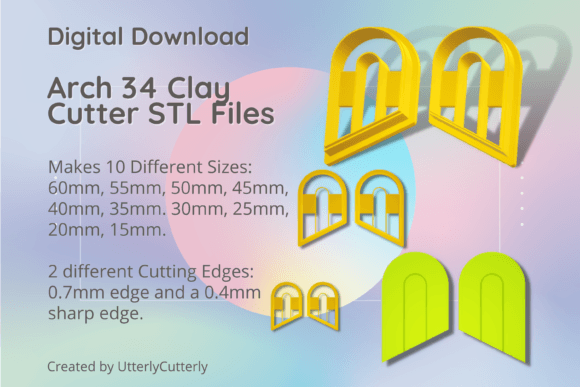
A critical decision factor when utilizing the Arch 34 Clay Cutter - STL Digital File D is selecting the appropriate blade geometry for the specific material at hand. This bundle includes two distinct cutter types, each serving different functional purposes. Understanding the tradeoffs between these profiles prevents material waste and ensures cleaner results.
The Standard 0.7mm Wall Profile
The standard version features a 0.7mm wall thickness with a 3mm thick base and a total height of 12mm. This profile is generally the more durable option and is best suited for:
- Firmer Clays: Materials like Sculpey III or firmer porcelain pastes that offer resistance during cutting.
- High-Volume Production: The thicker wall reduces the risk of layer separation or snapping during repetitive use.
- Beginner Printing: A 0.7mm wall is more forgiving on printers with slight calibration issues or older nozzles.
While robust, the 0.7mm edge may leave a slightly rounded impression on very soft clays, requiring minor post-processing cleanup if a razor-sharp boundary is required.
The Sharp Edge (SE) Profile
Abbreviated as "SE" in the file naming convention, this variant utilizes a 1mm support wall tapering to a 0.4mm cutting edge. Despite having a thinner contact point, the wider support wall maintains the same 3mm base and 12mm height as the standard version. This design addresses a common limitation in clay cutter manufacturing: the fragility of thin blades.
The SE profile is the superior choice for soft polymer clays, fondant, or gum paste where drag and distortion are primary concerns. The 0.4mm edge slices through material with minimal displacement, preserving the integrity of delicate arch shapes. However, users should note that printing a 0.4mm feature requires a well-tuned printer, ideally with a 0.4mm nozzle and optimized flow rate settings. If your printer struggles with fine details, the standard profile remains a safer, albeit less precise, alternative.
Evaluating Size Gradation and Workflow Integration
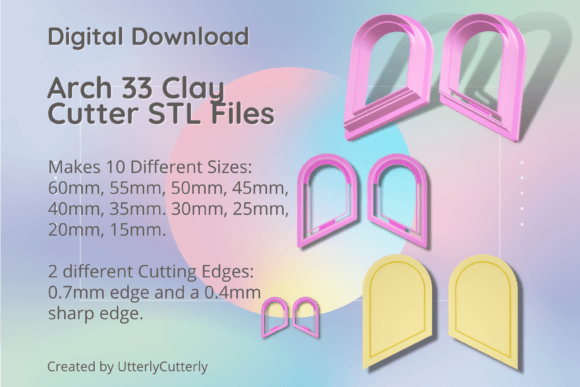
Versatility in digital fabrication is defined by scalability. The Arch 34 Clay Cutter - STL Digital File D includes ten discrete sizes ranging from 15mm to 60mm in 5mm increments (15mm, 20mm, 25mm, 30mm, 35mm, 40mm, 45mm, 50mm, 55mm, 60mm). Measurements are taken from the longest ends of the arch, ensuring predictable sizing relative to other geometric cutters in your collection.
This systematic gradation offers significant advantages over ad-hoc collections of individual files. When designing jewelry, for example, having consistent 5mm steps allows for seamless nesting or graduated stacking without visual gaps. For cookie decoration, the range covers standard industry sizes from miniature accents to large statement pieces. Users comparing this bundle to single-size downloads should consider the long-term value of having a complete set; purchasing individual sizes later often incurs higher cumulative costs and creates versioning inconsistencies.
Embossing Compatibility and Material Thickness
An important technical specification for users intending to use these cutters for textured work involves the embossing line height. Any embossing details integrated into related designs in this series are 10.5mm tall. Consequently, these tools are optimized for clay sheets thicker than 1.5mm. Attempting to use these cutters on paper-thin veneers may result in incomplete cuts or bottoming out before the shape is fully formed. Makers working exclusively with ultra-thin slabs (under 1mm) may need to seek specialized low-profile cutters instead.
Comparative Analysis: Digital STL vs. Physical Alternatives
When researching clay shaping tools, makers typically choose between metal cutters, pre-printed plastic cutters, and digital STL files like the Arch 34 Clay Cutter - STL Digital File D. Each format presents distinct strengths and limitations depending on production volume and customization needs.
Metal Cutters
Stainless steel or copper cutters remain the industry standard for professional bakeries and high-end ceramics due to their longevity and heat resistance. However, metal options are limited to mass-produced shapes. Finding a specific architectural arch curve in metal often requires custom fabrication, which can be cost-prohibitive. Metal cutters also lack the ergonomic handles or reinforced bases found in 3D-printed designs, which can cause hand fatigue during extended sessions.
Pre-Printed Plastic Cutters
Buying ready-made plastic cutters eliminates the need for owning a 3D printer. The tradeoff is dependency on supplier stock and shipping times. Furthermore, commercial plastic cutters are often printed with lower infill or faster layer heights to reduce manufacturing costs, potentially compromising durability compared to a user-controlled print. With the Arch 34 digital file, you control the infill density, wall count, and material quality, allowing you to engineer the tool to your exact durability requirements.
Digital STL Files
The primary advantage of the Arch 34 Clay Cutter - STL Digital File D is iteration speed. If a design needs adjustment or a new size is required mid-project, the solution is immediate. The tradeoff is the requirement for hardware and technical knowledge. Users without a 3D printer must factor in the cost of entry or utilize local printing services, which negates some convenience benefits. However, for those already equipped with printing capabilities, digital files offer the lowest marginal cost per tool and the highest degree of design autonomy.
Decision Factors: When This Asset Is the Right Fit
Selecting the right digital asset requires honest assessment of current capabilities and project goals. The Arch 34 Clay Cutter - STL Digital File D is likely the optimal choice if:
- You Require Geometric Consistency: The parametric nature of this file set ensures that every arch shares identical curvature ratios across all sizes, unlike hand-modeled or scanned alternatives.
- You Own a Calibrated FDM Printer: Resin printers can produce smoother finishes but often lack the structural strength needed for clay cutting. This file is optimized for FDM thermoplastics like PLA or PETG.
- You Value Iterative Design: As part of a growing ecosystem with weekly releases, this file integrates with future additions, allowing for curated combo sets that maintain stylistic coherence.
- You Work Within Specific Thickness Parameters: Your typical clay conditioning setup produces sheets between 1.5mm and 10mm, aligning with the tool’s 12mm height and embossing specifications.
Conversely, alternative resources may be preferable if you primarily work with extremely abrasive materials (requiring metal), lack access to 3D printing infrastructure, or require food-safe certification that cannot be guaranteed with consumer-grade 3D printing materials. Always verify material safety data sheets for filaments used in food-contact applications.
Technical Considerations for Successful Fabrication
To maximize the utility of the Arch 34 Clay Cutter - STL Digital File D, proper print preparation is as important as the file itself. All cutters in this bundle are tested prior to release, but successful reproduction depends on user settings. For the Sharp Edge variants, ensure your slicer is configured to print outer walls first to maintain dimensional accuracy. A brim is rarely necessary given the 3mm base width, but a raft may be beneficial for the smaller 15mm and 20mm sizes to prevent bed adhesion failures.
Material selection also influences performance. PLA offers excellent stiffness and detail resolution, making it ideal for the SE profile. PETG provides greater flexibility and chemical resistance, which may extend tool life when working with certain clay conditioners or release agents, though it can be more prone to stringing on fine edges. Testing both blade profiles with your preferred filament before committing to a full production run is recommended practice.
Ultimately, the value of this digital bundle lies in its specificity and adaptability. By providing dual blade options and comprehensive sizing, it addresses the varied needs of modern makers who bridge digital design and tactile craft. Whether producing intricate jewelry components or uniform baked goods, having direct control over tool fabrication empowers creators to maintain quality standards that off-the-shelf solutions cannot always guarantee. As with any digital manufacturing resource, success comes from matching the tool’s technical parameters to your specific material constraints and production environment.