Antique Vase 2 Clay Cutter STL Digital: Technical Specifications and Creative Applications
The intersection of traditional craftsmanship and modern additive manufacturing has revolutionized how artisans approach polymer clay, ceramic slip, and cookie dough. Central to this evolution is the availability of high-precision digital assets like the Antique Vase 2 Clay Cutter STL Digital. This specific digital download bundle represents a shift away from mass-produced, generic tools toward customizable, on-demand fabrication. By providing immediate access to stereolithography files, creators can produce professional-grade cutting implements tailored to exact dimensional requirements. Understanding the technical nuances of these STL files is essential for maximizing print quality and ensuring the final physical tool performs as intended across various mediums.
Dual-Edge Engineering for Material Versatility
A defining characteristic of this digital pack is the inclusion of two distinct cutting edge profiles within the same design set. This duality addresses the varying mechanical properties of different modeling materials. Not all clays or doughs respond identically to shear force; therefore, having selectable blade geometries allows the user to optimize their workflow based on the substrate at hand.
The Standard 0.7mm Wall Configuration
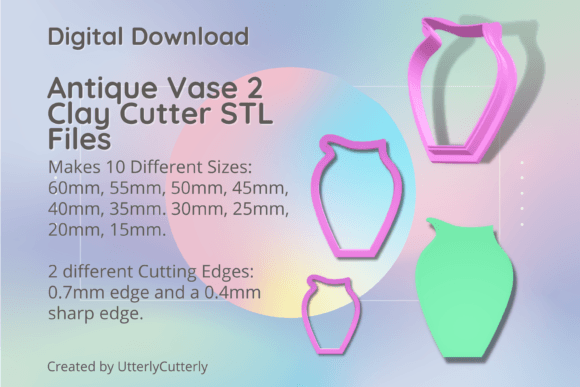
The first cutter type features a 0.7mm wall thickness with a matching 0.7mm cutting edge. This geometry is engineered for durability and structural rigidity. When working with firmer polymer clays or denser ceramic bodies, a thinner blade may flex or deform under pressure, leading to distorted shapes. The 0.7mm profile provides sufficient mass to resist bending while maintaining enough sharpness to slice through standard conditioning clay without excessive drag. This version serves as the workhorse option for general jewelry making and thicker ceramic slab work where edge definition is secondary to shape integrity.
The Sharp Edge (SE) Variant
For applications requiring pristine detail and minimal material displacement, the Sharp Edge variant—abbreviated as SE in the file nomenclature—is indispensable. This design utilizes a 1mm support wall that tapers down to a precise 0.4mm cutting edge. The wider base ensures the cutter remains robust during printing and handling, while the refined tip delivers a cleaner incision. This geometry is particularly advantageous for soft polymer clays, fondant, or cookie dough, where a thicker blade might compress the material rather than cut it. The reduced surface area of the cutting edge minimizes friction, resulting in smoother edges that require less post-processing cleanup. Users should note that while sharper, this edge requires careful handling and appropriate printer calibration to avoid layer separation at the taper point.
Dimensional Hierarchy and Scaling Logic
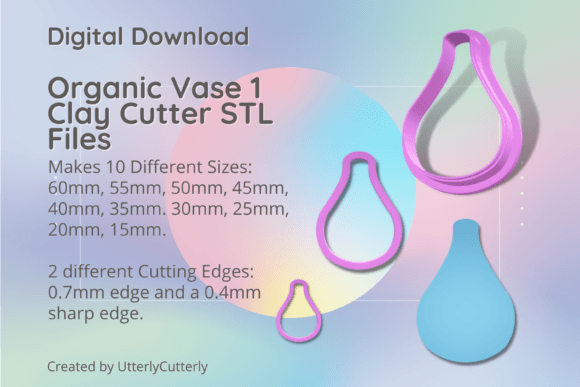
Versatility in design often hinges on scale. A motif that works beautifully as a pendant may lose its impact as a large vase decoration or become unrecognizable as a tiny earring charm. This STL bundle addresses scalability through ten discrete size increments, measured from the longest ends of the cutter. The available sizes are 60mm, 55mm, 50mm, 45mm, 40mm, 35mm, 30mm, 25mm, 20mm, and 15mm.
This granular sizing strategy facilitates cohesive collection building. For jewelry makers, the ability to create graduated sets—such as nesting pendants or tiered earrings—from the same antique vase silhouette ensures visual consistency that is difficult to achieve when sourcing individual cutters from disparate designers. Furthermore, the standardized sizing allows for predictable integration with other digital assets. Creators curating custom cutter combos can confidently mix this vase design with complementary floral or geometric STL files, knowing that the 40mm vase will proportionally align with other 40mm elements in their library.
Base and Height Standardization
Regardless of the chosen footprint size or edge type, both cutter variants maintain consistent vertical dimensions. Each cutter possesses a 3mm thick base and a total height of 12mm. The 3mm base acts as a stabilizing flange, preventing the cutter from twisting during use and providing a comfortable grip surface for the thumb. The 12mm height offers adequate clearance for most polymer clay slabs and rolled cookie doughs, ensuring the user’s fingers do not contact the material being cut. This uniformity simplifies storage and organization, as all printed tools stack or nest predictably despite their varying widths.
Embossing Integration and Clay Thickness Considerations
Beyond simple outline cutting, many antique vase designs incorporate internal texture or embossing lines to add depth and historical authenticity. It is critical to understand the relationship between embossing height and raw material thickness to avoid failed prints or damaged artwork. In this digital pack, any embossing lines are designed to be 10.5mm tall.
Given the total cutter height of 12mm, this leaves only 1.5mm of clearance above the embossed feature. Consequently, users must condition their clay to a thickness greater than 1.5mm before using the embossing function. If the clay is too thin, the embossing line will penetrate completely through the slab, sticking to the cutter interior and potentially tearing the piece upon removal. Adhering to this minimum thickness guideline ensures the texture impresses cleanly into the surface without compromising the structural integrity of the workpiece. This specification highlights the importance of reading technical documentation before printing; digital files are precise instruments that demand equally precise preparation.
Additive Manufacturing Best Practices for STL Files
While these cutters are designed to be easily printed, achieving optimal results requires attention to slicer settings and material selection. The transition from digital file to functional tool depends heavily on the user's understanding of their specific 3D printer's capabilities.
- Layer Height and Resolution: For the Sharp Edge (SE) variants, a layer height of 0.12mm or lower is recommended to preserve the 0.4mm tip geometry. Thicker layers may create a stepped effect that blunts the cutting edge before it even reaches the bed.
- Infill and Perimeters: Cutters do not require high infill densities; 15-20% is typically sufficient. However, increasing perimeter shells to three or four enhances wall strength, which is more beneficial for cutting performance than internal fill.
- Material Selection: Food-safe PLA is mandatory for cookie and fondant applications. For polymer clay, standard PLA, PETG, or resin are acceptable. Resin prints offer superior smoothness but require thorough post-curing and washing to prevent chemical contamination of the clay.
- Orientation: Always print cutters with the base flat on the build plate. Printing upside down or at an angle introduces unnecessary supports that degrade the cutting edge quality and increase post-processing labor.
Workflow Integration for Professionals and Hobbyists
The utility of the Antique Vase 2 Clay Cutter STL Digital extends beyond the physical object; it streamlines the creative workflow. For business owners and professional artisans, digital inventory eliminates shipping delays and storage constraints. New designs arrive weekly, allowing shops to refresh their product lines rapidly in response to seasonal trends or customer requests without waiting for physical supply chains.
Educators and workshop leaders benefit from the reproducibility of STL files. Instead of purchasing expensive pre-made sets that may break or go missing, instructors can print fresh batches of cutters for each class session at a fraction of the cost. The ability to replace a single lost 25mm cutter without repurchasing an entire set makes digital assets economically superior for high-volume environments.
Researchers and designers exploring historical motifs also find value in this format. The antique vase silhouette serves as a case study in translating classical aesthetics into parametric design. By modifying the STL files in CAD software, users can experiment with scaling, stretching, or combining elements to create derivative works, fostering innovation while respecting traditional forms. This digital flexibility transforms the cutter from a static tool into a dynamic component of the design process.
Understanding Digital Deliverables and Usage Rights
It is imperative to recognize that this product is strictly a digital download. No physical item will be shipped. Access to the files is granted immediately following payment confirmation, enabling instant utilization. This distinction affects how users should approach their purchase; there is no return logistics for a digital file, so verifying printer compatibility and understanding the technical specifications outlined above is part of the acquisition process.
All cutters in this bundle undergo testing prior to release to ensure printability and functional performance. However, "tested" implies validation under specific conditions. Variations in printer calibration, filament quality, and environmental factors mean that individual results may vary. Users should treat the provided specifications as a baseline and perform test prints when introducing new materials or changing machine settings. This proactive approach ensures that the Antique Vase 2 Clay Cutter STL Digital remains a reliable asset in the maker’s toolkit, bridging the gap between vintage inspiration and contemporary fabrication technology.