Arch 31 Clay Cutter - Boho Shape STL Dig: A Practical Guide to Digital Downloads
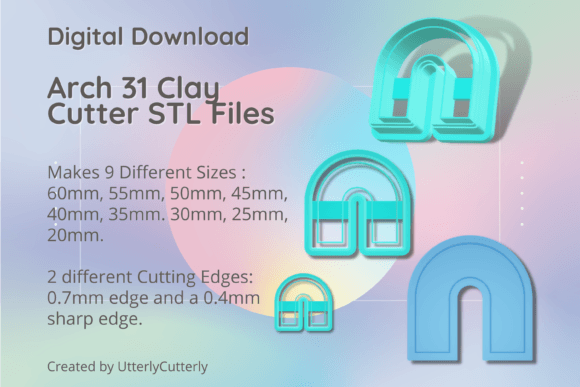
For polymer clay artists, cookie decorators, and small business owners, the transition from purchasing physical tools to downloading digital assets represents a significant shift in workflow. The Arch 31 Clay Cutter - Boho Shape STL Dig offers immediate access to versatile designs, but it also requires a specific level of technical understanding to be useful. Unlike buying a finished metal or plastic cutter, acquiring an STL file bundle means you are responsible for the manufacturing quality. This digital download includes nine distinct sizes ranging from 20mm to 60mm and two specialized cutting edge profiles, providing ample variety for jewelry making and baking. However, without proper preparation and printer calibration, even the best-designed file can result in unusable tools.
Understanding the Two Cutting Edge Profiles
A common mistake when printing clay cutters is treating all STL files as identical. This pack includes two distinct cutter types, and confusing them leads to frustration during use. You must select the correct profile for your specific material and project requirements before hitting print.
- Standard Wall (0.7mm): This version features a 0.7mm wall thickness with a 3mm thick base and a 12mm height. It is generally more durable and easier to print successfully on standard FDM printers. This is often the better choice for beginners or for cutting stiffer materials like cookie dough where extreme sharpness is less critical than structural integrity.
- Sharp Edge (SE): Abbreviated as SE in the file names, this variant has a 1mm support wall tapering to a precise 0.4mm cutting edge. While superior for clean cuts in polymer clay, the thin edge is more susceptible to printing artifacts and damage. If your printer is not perfectly calibrated, the 0.4mm edge may fail to adhere or become jagged.
Selecting the Sharp Edge version for heavy-duty cookie work may result in premature wear or breakage, while using the Standard Wall for delicate jewelry clay might leave rough edges requiring excessive post-processing. Always check the file suffix to ensure you are printing the intended variation.
Sizing Accuracy and Measurement Standards
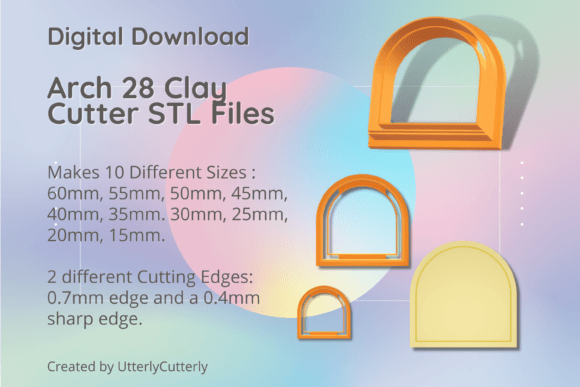
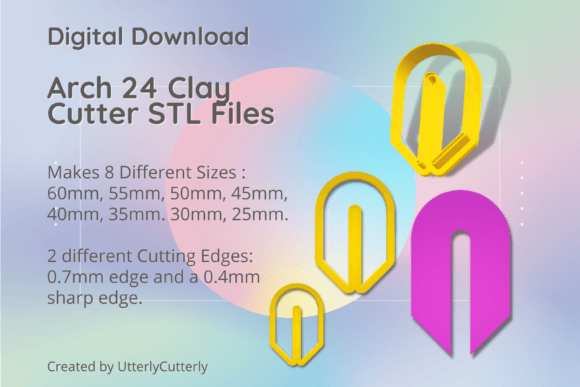
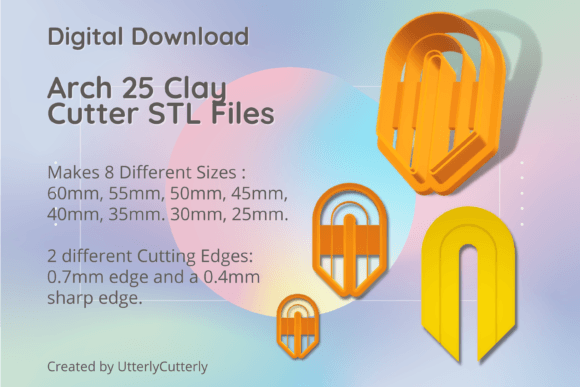
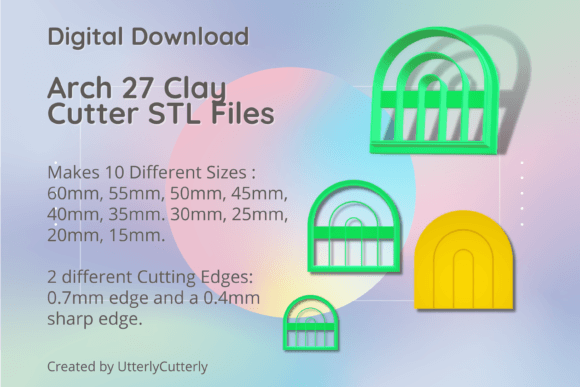
Misunderstanding how cutter sizes are listed is a frequent source of disappointment. When evaluating the Arch 31 Clay Cutter - Boho Shape STL Dig, note that the size is measured from the longest ends of the shape. This is an industry-standard measurement, but it differs from measuring width or internal area. The available sizes in this bundle are 60mm, 55mm, 50mm, 45mm, 40mm, 35mm, 30mm, 25mm, and 20mm.
If you are designing a jewelry collection with specific dimensional constraints, do not assume a "40mm" cutter will produce a 40mm wide arch. The boho shape’s curvature means the visual footprint may appear smaller than the maximum length measurement. Before committing to a full production run, print a single test cutter and measure the actual output against your design mockups. Relying solely on the digital filename without physical verification can lead to mismatched components in earrings or pendants.
Critical Considerations for Embossing Lines
This STL bundle includes embossing details that add texture to your creations, but they introduce specific limitations. The embossing lines are designed at 10.5mm tall. This dimension is intentional; it ensures the detail presses into the material without bottoming out. However, this only works effectively if your clay slab is thicker than 1.5mm.
Attempting to use these cutters on thinly rolled clay (less than 1.5mm) will result in the embosser hitting the work surface or tearing through the material. Conversely, if your clay is significantly thicker than the cutter's functional depth, the embossing may not register clearly. Adjust your pasta machine settings or rolling pin guides to match the tool’s specifications rather than forcing the tool to adapt to inconsistent clay thickness.
Optimizing Print Settings for Durability
The most overlooked aspect of using digital cutter files is print orientation and adhesion. These cutters feature a 3mm thick base specifically designed to improve bed adhesion and provide a comfortable grip. Despite this, prints can still fail if settings are ignored.
- Brim Usage: Even with a 3mm base, the narrow walls of the SE (Sharp Edge) variant have minimal surface contact. Always use a brim when printing the 0.4mm edge versions to prevent warping or detachment mid-print.
- Layer Height: For the sharpest possible edge, use the lowest layer height your printer can reliably handle (typically 0.12mm or lower). Thicker layers create a stair-stepping effect on the cutting edge that requires tedious sanding.
- Infill and Walls: Do not rely on infill for strength. Increase the number of perimeter walls instead. A cutter with 4+ walls and low infill is stronger and faster to print than one with high infill and few walls.
Neglecting these settings often results in brittle cutters that snap under pressure or dull edges that drag rather than slice. Since you have the digital file, reprinting is inexpensive, but time spent on failed prints reduces your overall efficiency.
Verifying File Integrity and Safety
Because this is a digital download and not a physical item, you cannot inspect the product before purchase. After downloading, always verify the STL files in your slicer software before printing. Check for non-manifold geometry or holes in the mesh, which can occur during file transfer or conversion. Most modern slicers will auto-repair minor issues, but significant errors indicate a corrupted download.
Additionally, consider food safety if you intend to use these for cookies. 3D printed plastics have layer lines that harbor bacteria. Even if you use food-safe filament, the printed part itself is rarely food-safe without additional sealing. Many professionals use 3D printed cutters solely for shaping and then sanitize the dough separately, or they coat the cutter in a food-grade epoxy. Never assume an STL file labeled for cookies implies the final printed object is automatically safe for direct food contact without proper post-processing.
Curating a Versatile Tool Library
One advantage of the Arch 31 Clay Cutter - Boho Shape STL Dig is its compatibility with other digital assets. With new STL files added to the store weekly, you can build a cohesive collection over time. However, avoid the trap of downloading every new release without a plan. Instead, curate combos based on proportional relationships.
The nine sizes included here follow a 5mm increment pattern. When expanding your library, look for complementary shapes that share this scaling logic or offer intentional contrast. Mixing random sizes from different designers often leads to a disjointed product line. Use the 2mm border specification as a benchmark; maintaining consistent wall-to-edge ratios across different shapes ensures uniform pressure distribution and predictable results, whether you are creating polymer clay earrings or stamped biscuits.
By approaching digital cutter files with technical awareness and practical foresight, you transform a simple download into a reliable production asset. Understanding the nuances between edge types, respecting dimensional tolerances, and optimizing your printing process ensures that the Arch 31 Boho Shape serves your creative business effectively for years to come.