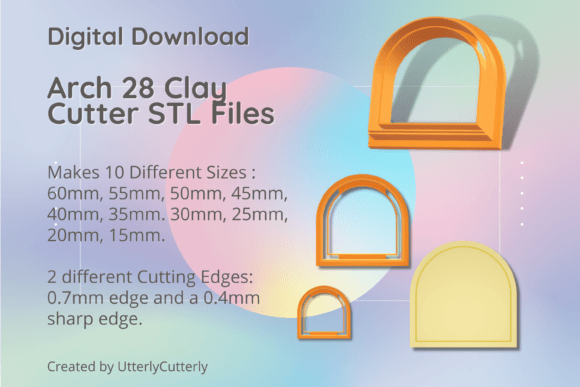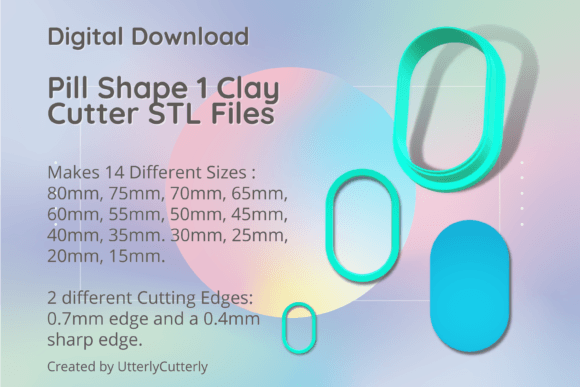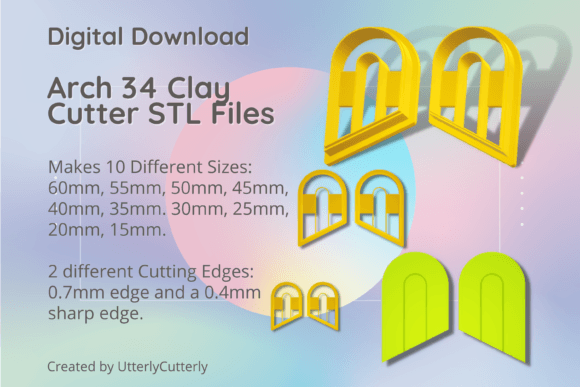
Peaked Shape 1 Clay Cutter STL: Digital File Evaluation and Specifications
The Peaked Shape 1 Clay Cutter - STL Digital is a downloadable 3D printing file set designed for creators who manufacture custom tools for polymer clay, ceramic, or cookie applications. Unlike physical cutters shipped via mail, this product provides immediate access to digital geometry that users can fabricate on-demand using FDM (Fused Deposition Modeling) or resin 3D printers. The bundle focuses on geometric versatility, offering a specific peaked silhouette in ten incremental sizes and two distinct cutting edge profiles. For makers evaluating whether to add this asset to their digital library, understanding the technical specifications, printability, and practical application of these files is essential for determining alignment with current production workflows.
Technical Specifications and Edge Profiles
A critical factor in selecting any clay cutter STL is the relationship between wall thickness, cutting edge sharpness, and structural integrity. The Peaked Shape 1 pack addresses varying material resistance by providing two distinct cutter types within the same size range. Understanding the difference between these profiles helps users select the correct file for their specific medium.
- Standard Wall Profile: This version features a 0.7mm wall thickness with a matching 0.7mm cutting edge. It sits on a 3mm thick base with a total height of 12mm. This profile offers increased rigidity, making it suitable for firmer clays or repeated use where thin walls might warp under pressure.
- Sharp Edge (SE) Profile: Abbreviated as "SE" in the file names, this variant utilizes a 1mm support wall that tapers to a precise 0.4mm cutting edge. Like the standard version, it has a 3mm base and 12mm height. The reduced contact area at the cutting point allows for cleaner slices through softer materials like fondant or conditioned polymer clay, reducing drag and deformation.
Both profiles share a consistent 12mm height, which is an industry-standard dimension for hand-held clay tools. This height provides adequate clearance for knuckles while maintaining enough surface area for the user to apply even downward pressure without the tool flexing excessively.
Sizing Strategy and Design Versatility
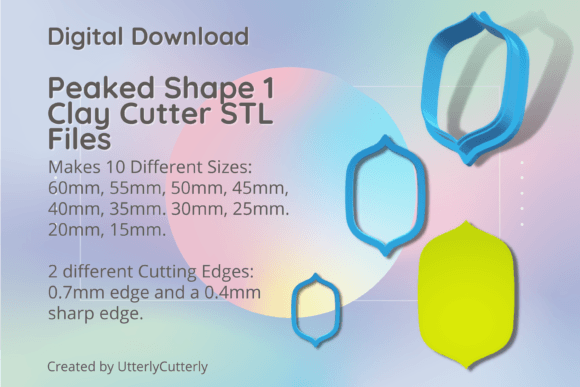
The utility of the Peaked Shape 1 Clay Cutter - STL Digital lies in its graduated sizing system. Rather than offering a single dimension, the pack includes ten sizes measured from the longest ends: 60mm, 55mm, 50mm, 45mm, 40mm, 35mm, 30mm, 25mm, 20mm, and 15mm. This 5mm increment step allows for precise nesting and scaling in design projects.
For jewelry makers, the smaller increments (15mm–30mm) are particularly relevant for creating earring components, pendants, and charms where subtle size variations dictate visual balance. The larger sizes (35mm–60mm) serve broader applications, including cookie decoration, ceramic tile stamping, or large-scale sculptural elements. When evaluating this pack, consider whether the 5mm graduation matches your existing inventory. If your current collection uses 10mm steps, this pack fills significant gaps. If you already possess similar peaked shapes in these exact dimensions, the value proposition shifts toward the specific edge quality or the unique geometry of this particular peak design.
Printability and Manufacturing Considerations
Digital cutter files must be optimized for consumer-grade 3D printers to be viable. The Peaked Shape 1 files are designed with printability as a primary constraint. The 3mm base width ensures sufficient bed adhesion during printing, reducing the risk of warping or detachment that often plagues thinner cutter bases. However, users should evaluate their printer’s capabilities against the file requirements before purchase.
The Sharp Edge (SE) variant requires a nozzle diameter of 0.4mm or smaller and precise flow rate calibration. Printers with worn nozzles or poor retraction settings may struggle to produce the clean 0.4mm edge, potentially resulting in a blunt tool that tears rather than cuts. Conversely, the 0.7mm standard profile is more forgiving and can typically be printed successfully on machines with minor calibration issues or 0.6mm nozzles. Users should also note that if embossing lines are present in future updates or related files, they are designed at 10.5mm tall. This necessitates a clay slab thickness greater than 1.5mm to prevent the embosser from bottoming out, a crucial consideration for those working with ultra-thin veneers.
Evaluating Fit: When to Choose Digital Over Physical
Selecting the Peaked Shape 1 Clay Cutter - STL Digital over a pre-manufactured physical cutter involves tradeoffs. The digital format is advantageous for makers who require immediate access to tools without shipping delays. It also benefits those who need to replace broken tools instantly or customize print settings (such as infill density or material color) for personal preference. Furthermore, owning the STL allows for indefinite reproduction; if a cutter breaks during a production run, a replacement can be printed in under an hour.
However, alternatives may be worth considering for users without reliable 3D printing infrastructure. Printing functional cutters requires time, material cost, and post-processing (removing supports, sanding edges). For hobbyists who only need one or two sizes, purchasing a physical cutter may be more economical when factoring in filament waste and machine depreciation. Additionally, injection-molded plastic cutters often possess smoother surface finishes than FDM prints, which can matter for high-gloss clay work where layer lines might transfer texture. This digital pack is best suited for makers who view 3D printing as an integrated part of their studio practice rather than an occasional novelty.
Practical Decision-Making Insights
When integrating this bundle into a workflow, verify that the peaked geometry complements your aesthetic direction. Geometric cutters create distinct negative space and stacking opportunities that organic shapes cannot replicate. Review sample renders or test prints at the smallest size (15mm) first, as fine details are most likely to fail at lower scales. Successful small-scale prints indicate good file hygiene and appropriate tolerances.
Consider the long-term value of the ecosystem. Since new STL files are added weekly, this pack functions as an entry point to a broader library. Evaluate whether the design language of Peaked Shape 1 aligns with other available sets to ensure future purchases will remain cohesive. Finally, remember that this is strictly a digital product; no physical item will arrive. Access is granted immediately post-payment, allowing for rapid prototyping but placing the burden of manufacturing quality entirely on the end user. By assessing printer readiness, material compatibility, and design needs against these specifications, creators can make an informed decision about whether this digital asset supports their production goals.