North Star 3 Clay Cutter - Celestial STL: Digital File Evaluation
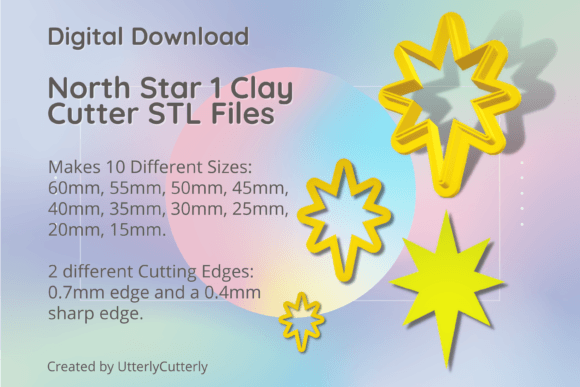
The North Star 3 Clay Cutter - Celestial STL is a digital asset designed for makers who utilize FDM or resin 3D printers to create custom tools for polymer clay, ceramic clay, and cookie dough. Unlike physical products shipped via mail, this item exists solely as a downloadable STL file bundle. It provides the geometric data necessary to print a versatile set of celestial-themed cutters in-house. For artisans and hobbyists evaluating their tooling options, understanding the specific technical parameters, sizing variations, and practical applications of this digital pack is essential for determining if it aligns with current production needs.
Technical Specifications and Print Variations
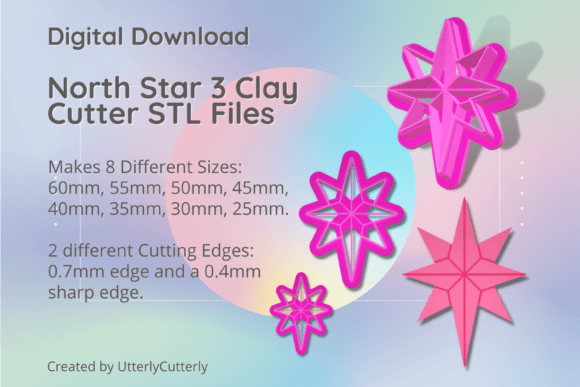
A primary consideration when selecting digital cutter files is the engineering behind the cutting edge and structural integrity. The North Star 3 Clay Cutter - Celestial STL bundle addresses diverse material requirements by including two distinct cutter profiles within the same size range. This duality allows users to adapt their tools based on whether they are working with soft polymer clay, firmer ceramic bodies, or food-safe doughs.
- Standard Wall Profile: This variation features a 0.7mm wall thickness paired with a 3mm thick base and a total height of 12mm. The wider wall offers increased rigidity, making it suitable for stiffer clays where lateral pressure might distort thinner blades. It provides a balance between sharpness and durability.
- Sharp Edge (SE) Profile: Abbreviated as SE in the file naming convention, this version utilizes a 1mm support wall that tapers to a precise 0.4mm cutting edge. Like the standard version, it maintains a 3mm base and 12mm height. The reduced contact surface area at the blade tip facilitates cleaner cuts in softer materials and reduces drag, which is critical for maintaining detail in intricate celestial designs.
Both profiles share identical base dimensions to ensure consistency in handling, but the choice between them should be dictated by the specific medium being manipulated. Users must also note that any embossing lines included in the design are 10.5mm tall. Consequently, these cutters require a clay slab thickness exceeding 1.5mm to function correctly without bottoming out or distorting the impression.
Sizing Versatility and Design Scalability
Versatility in jewelry and pottery making often depends on having graduated sizes rather than a single fixed dimension. This digital bundle includes eight discrete sizes, measured from the longest ends of the star geometry. The available dimensions are 60mm, 55mm, 50mm, 45mm, 40mm, 35mm, 30mm, and 25mm.
This granular sizing strategy supports several practical workflows:
- Nesting and Layering: The 5mm increment between sizes allows for consistent spacing when creating layered pendants or stacked ceramic vessels.
- Shrinkage Compensation: Ceramic clays shrink during drying and firing. Having multiple sizes enables potters to select a cutter that accounts for specific clay body shrinkage rates to achieve a target final dimension.
- Jewelry Scaling: The smaller 25mm and 30mm options cater specifically to earring and charm production, while larger sizes suit statement pieces or cookie applications.
For makers curating a cohesive collection, these standardized increments integrate well with other STL files from the same ecosystem, facilitating modular design systems rather than disjointed toolsets.
Evaluating Suitability for Different Workflows
Determining whether the North Star 3 Clay Cutter - Celestial STL is the right investment requires an honest assessment of your current setup and goals. Digital fabrication offers distinct advantages over purchasing pre-made physical cutters, but it also introduces variables that may not suit every user.
Ideal Use Cases
This digital pack is strongly aligned with users who possess a calibrated 3D printer and require immediate access to specific shapes. It is particularly beneficial for:
- High-Volume Producers: Makers who wear out plastic cutters can reprint replacements on demand at a negligible material cost.
- Customizers: Users comfortable with CAD software can modify the STL files to adjust wall thickness or add personalization before printing.
- International Makers: Eliminating shipping costs and wait times makes digital files economically superior for those outside major manufacturing hubs.
- Multi-Medium Artists: The inclusion of both sharp and standard edges maximizes the utility of a single purchase across different artistic disciplines.
Situations Where Alternatives May Be Preferable
Despite the flexibility of STL files, physical alternatives remain superior in specific contexts. Readers should consider traditional metal or pre-printed plastic cutters if:
- Printer Calibration is Uncertain: Cutting edges, especially the 0.4mm SE variant, require precise extrusion tuning. Under-extrusion leads to brittle blades; over-extrusion creates dull, unusable edges.
- Food Safety is Paramount: While 3D printed cutters can be used for cookies, layer lines can harbor bacteria. Commercial food production typically requires certified food-safe stainless steel or seamless molded plastics unless rigorous sanitization protocols are followed.
- Time Constraints Exist: Printing eight sizes in two variations requires significant machine time. For a one-time event next week, buying physical tools is more reliable than troubleshooting print failures.
- Material Hardness Exceeds PLA/PETG Limits: Standard 3D printing filaments may deform against very hard porcelain or dense doughs. Metal cutters offer superior longevity for industrial-grade materials.
Practical Considerations for Digital Acquisition
When acquiring the North Star 3 Clay Cutter - Celestial STL, users must recognize that this is strictly a non-physical transaction. Access to the files is granted immediately following payment confirmation. There is no physical inventory, and no item will arrive by post. This distinction is vital for buyers accustomed to traditional e-commerce fulfillment.
Furthermore, the quality of the final tool is dependent entirely on the user's hardware and slicing settings. The files are tested prior to release to ensure manifold geometry and printable tolerances, but successful outcomes rely on proper bed adhesion, appropriate layer heights (typically 0.12mm to 0.2mm for functional parts), and correct orientation. Printing the cutters vertically, standing on their base, is generally recommended to preserve the cutting edge geometry, though this may require brim supports to prevent tipping.
Ultimately, this digital bundle serves as a foundational resource for makers seeking autonomy in their tool creation process. By providing dual edge profiles and comprehensive sizing, it mitigates many common limitations associated with generic 3D printed cutters. However, its value is realized only through competent fabrication and appropriate application. Evaluating your printing capabilities alongside your creative requirements will determine if this celestial STL pack effectively bridges the gap between digital design and tangible craftsmanship.