Lightning Bolt 2 Clay Cutter - STL Digit: Technical Specifications and Usage Evaluation
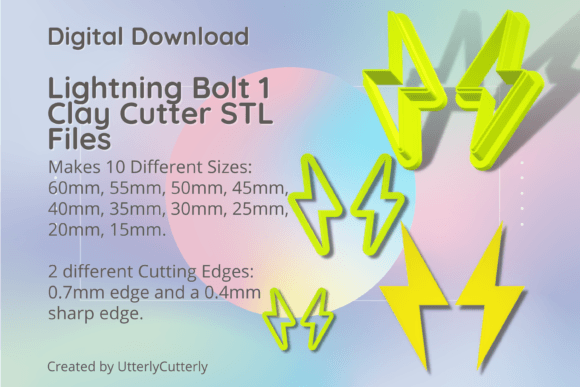
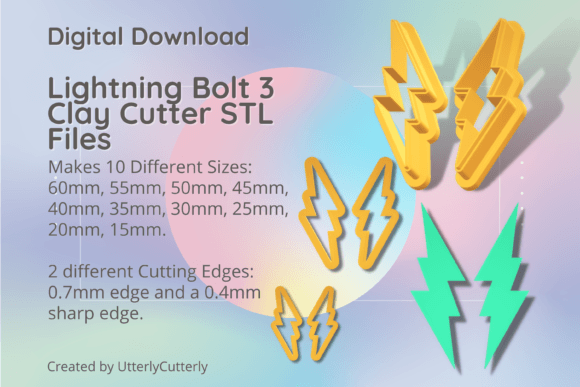
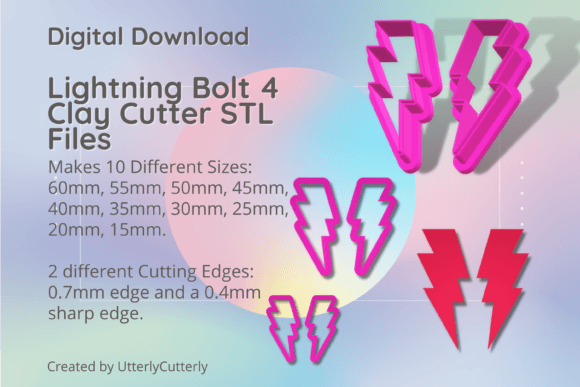
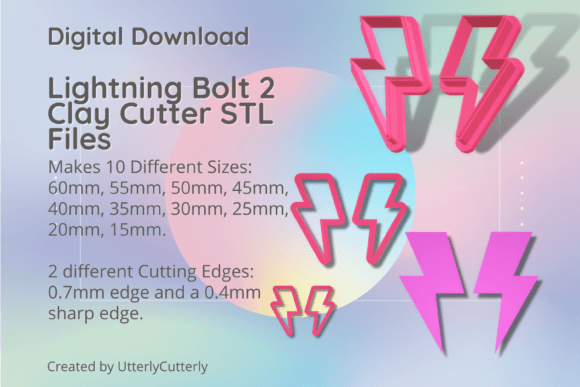
The Lightning Bolt 2 Clay Cutter - STL Digit represents a specific category of digital fabrication assets designed for polymer clay artists, ceramicists, and cookie decorators who own 3D printers. Unlike physical tools shipped via mail, this product is a downloadable bundle containing stereolithography (STL) files optimized for FDM or resin printing. The primary distinction of this digital asset lies in its dual-profile engineering and comprehensive size scaling, offering ten distinct dimensions ranging from 15mm to 60mm. For makers evaluating their tooling options, understanding the technical differences between the included cutter types is essential for achieving professional results without excessive post-processing.
Dual Cutting Edge Profiles: Standard vs. Sharp Edge
A critical decision factor when utilizing the Lightning Bolt 2 Clay Cutter - STL Digit is selecting the appropriate cutting profile for your specific material and project requirements. The bundle includes two distinct geometries, each serving different functional purposes. Understanding these tradeoffs prevents material waste and ensures the printed tool performs as expected.
The Standard Profile (0.7mm Wall)
The standard version features a 0.7mm wall thickness with a 3mm thick base and a total height of 12mm. This geometry prioritizes durability and ease of printing over extreme sharpness. The thicker wall provides structural rigidity, making it less prone to warping during the printing process or breaking under pressure when cutting through denser materials like firm polymer clay or rolled fondant.
- Best Fit: General-purpose cutting, softer clays, and users with entry-level 3D printers that may struggle with fine tolerances.
- Tradeoff: Leaves a slightly rounded edge on the clay that may require smoothing or beveling after cutting.
- Durability: High; resistant to snapping during demolding or cleaning.
The Sharp Edge Profile (SE)
Abbreviated as "SE" in the file names, this variant utilizes a 1mm support wall that tapers down to a precise 0.4mm cutting edge. While maintaining the same 3mm base and 12mm height as the standard version, the reduced contact surface area significantly decreases drag during the cutting motion. This profile is engineered for clean releases and crisp definitions.
- Best Fit: Detailed jewelry components, earring making, and projects requiring minimal post-cut sanding.
- Tradeoff: More susceptible to damage if dropped or cleaned aggressively; requires well-calibrated printer flow rates to prevent nozzle clogging or layer separation at the thin edge.
- Precision: Superior definition for intricate lightning bolt angles.
Size Scaling and Application Versatility
The utility of any clay cutter bundle depends heavily on whether the available sizes align with current design trends and practical manufacturing constraints. The Lightning Bolt 2 Clay Cutter - STL Digit addresses this by providing a graduated scale rather than a single static dimension. Size measurements are taken from the longest ends of the bolt shape, which is a crucial distinction for designers planning layout spacing.
The inclusion of ten sizes—15mm, 20mm, 25mm, 30mm, 35mm, 40mm, 45mm, 50mm, 55mm, and 60mm—allows for cohesive collection building. For example, a jeweler creating a graduated earring set might utilize the 60mm, 50mm, and 40mm variants within a single product line. Conversely, the smaller 15mm and 20mm cutters serve niche applications such as charm bracelets, nail art accents, or miniature cake decorations. When comparing this digital bundle to physical metal cutters, the ability to print only the sizes currently needed reduces upfront cost and storage requirements, though it introduces the time variable of printing and potential print failures.
Embossing Compatibility and Material Thickness
For artists incorporating texture into their work, dimensional compatibility is non-negotiable. The Lightning Bolt 2 Clay Cutter - STL Digit accounts for embossing workflows with specific internal clearances. If the design includes embossing lines, they are modeled at 10.5mm tall. Given the total cutter height of 12mm, this leaves a 1.5mm clearance buffer.
This specification dictates a minimum working clay thickness. Users must roll their material to greater than 1.5mm to ensure the embossed detail registers fully without the cutter bottoming out prematurely. Attempting to use this cutter with thinner sheets will result in incomplete impressions or structural weakness in the final piece. Makers accustomed to working with ultra-thin veneers (under 1mm) should evaluate whether this clearance aligns with their standard practices or if they require alternative tooling with shallower relief depths.
Digital Assets vs. Physical Tooling: Decision Factors
Choosing between purchasing the Lightning Bolt 2 Clay Cutter - STL Digit and acquiring traditional physical cutters involves weighing several operational variables. Neither option is universally superior; the right choice depends on production volume, equipment access, and customization needs.
When Digital STL Files Are Advantageous
The digital format excels in scenarios requiring flexibility and low-volume variety. Because new STL files are added to the store weekly, users can expand their toolkit incrementally without committing to large inventory purchases. This model benefits hobbyists and small business owners testing new designs before scaling up. Additionally, if a cutter breaks or wears out, replacement is instantaneous and free, eliminating supply chain delays. The ability to modify print settings—such as increasing infill for strength or adjusting wall counts for sharpness—offers customization impossible with fixed-manufacturing metal or plastic cutters.
When Physical Alternatives May Be Preferable
Despite the versatility of STL files, physical cutters retain advantages in specific contexts. High-volume production environments where printing time creates bottlenecks may find dedicated metal cutters more efficient. Metal tools also offer superior thermal conductivity, which can be beneficial when working with temperature-sensitive materials or when heating blades for cleaner cuts in certain plastics. Furthermore, users without reliable 3D printing infrastructure or those unwilling to manage printer maintenance, leveling, and filament quality will likely achieve more consistent results with professionally manufactured physical tools. The learning curve associated with printing thin-walled objects like the SE variant can be steep for beginners.
Printability and Quality Assurance
The Lightning Bolt 2 Clay Cutter - STL Digit is explicitly designed for printability, but success depends on user calibration. The 3mm base provides adequate bed adhesion, reducing the likelihood of prints detaching mid-job—a common failure point for narrow, tall objects. However, the transition from the 3mm base to the cutting edge requires proper cooling management. Insufficient part cooling can cause the thin walls to soften and deform, resulting in wavy or inaccurate cutting edges.
Users should verify their printer’s dimensional accuracy before committing to large batches. A test print of the smallest size (15mm) is recommended to validate that the 0.4mm SE edge resolves correctly. If the edge appears fused or blobby, adjusting retraction settings, reducing print speed for outer walls, or switching to a smaller nozzle diameter may be necessary. This validation step distinguishes successful digital fabrication from frustrating trial-and-error cycles.
Evaluating Long-Term Value and Workflow Integration
The economic evaluation of this digital bundle extends beyond the initial purchase price. While the per-unit cost approaches zero after acquisition, the true cost includes printer depreciation, filament consumption, electricity, and most significantly, operator time. For makers already printing regularly, the marginal cost of adding these cutters to existing print jobs is negligible. For those purchasing a printer solely for this purpose, the break-even point requires substantial usage.
Integration into existing workflows also matters. The standardized 12mm height ensures compatibility with common clay roller guides and pasta machine settings used by many artisans. Consistency across different cutter shapes in the store’s catalog allows makers to swap tools mid-project without recalibrating clay thickness or handling techniques. This interoperability adds value beyond individual cutter specifications, supporting a systematic approach to digital craft tooling rather than isolated, incompatible purchases.
Ultimately, the Lightning Bolt 2 Clay Cutter - STL Digit serves makers who prioritize customization, immediate access, and iterative design capability over the plug-and-play simplicity of physical tools. By understanding the technical distinctions between cutting profiles, respecting dimensional constraints for embossing, and realistically assessing printing capabilities, users can determine whether this digital resource aligns with their creative and operational objectives.