Lightning Bolt 3 Clay Cutter - STL Digit: Strategic Asset for Makers
Acquiring the Lightning Bolt 3 Clay Cutter - STL Digit represents more than a simple transaction for a 3D printing file; it is an investment in production consistency and creative scalability. For polymer clay artists, cookie decorators, and small business owners, the transition from physical tools to digital assets fundamentally changes operational flexibility. This specific digital download provides immediate access to a versatile cutting system designed for high-volume output and precise aesthetic control. By integrating this STL bundle into your workflow, you secure the ability to produce ten distinct sizes across two specialized edge profiles without waiting for shipping or relying on third-party inventory.
The strategic value of this digital asset lies in its capacity to standardize your product line while minimizing overhead. Whether you are curating a cohesive jewelry collection or preparing for a seasonal baking rush, having the source files allows for on-demand manufacturing. You eliminate the risk of discontinued molds and gain the autonomy to replace worn tools instantly. This level of operational control is essential for professionals who need to maintain brand consistency across hundreds of units while adapting quickly to market trends or custom client requests.
Technical Specifications and Production Planning
Effective use of the Lightning Bolt 3 Clay Cutter - STL Digit requires understanding the technical parameters embedded in the design. This is not a generic shape; it is an engineered tool with specific tolerances intended for different material behaviors. The bundle includes two distinct cutter types, each serving a unique function in your production pipeline. Recognizing when to deploy each variant is critical for achieving professional-grade results and reducing post-processing time.
- Standard Edge (0.7mm Wall): This variant features a 0.7mm wall thickness with a 3mm thick base and a total height of 12mm. It is engineered for durability and general-purpose cutting. The thicker wall provides structural rigidity during the pressing motion, making it ideal for stiffer clays or doughs that require significant force. This is your workhorse cutter for high-volume production where longevity and ease of handling are priorities.
- Sharp Edge (SE): Abbreviated as SE in the file names, this version utilizes a 1mm support wall tapering to a precise 0.4mm cutting edge. Like the standard version, it maintains a 3mm base and 12mm height. The reduced contact surface area significantly decreases drag and deformation, resulting in cleaner cuts that require minimal sanding or trimming. Reserve this profile for delicate polymer clay work, detailed fondant, or any application where edge definition directly impacts perceived quality.
Both cutter types share a consistent 12mm height and 3mm base thickness. This uniformity is intentional, allowing makers to switch between edge profiles without adjusting their rolling guides or slab thickness settings. When planning your print farm or batch printing schedule, consider producing multiples of the Sharp Edge variants if your primary output is fine jewelry, as these edges may wear faster than the standard 0.7mm walls. Conversely, keep a higher stock of standard cutters for general prototyping and heavier materials.
Sizing Strategy for Product Cohesion
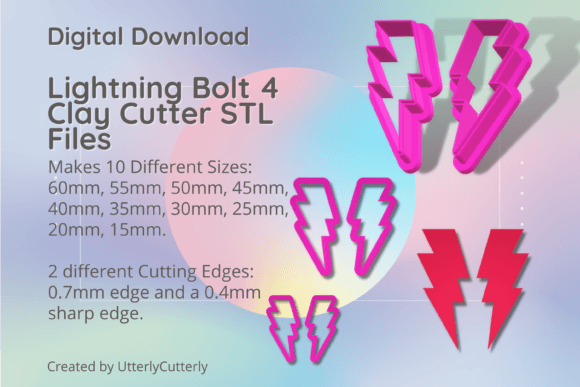
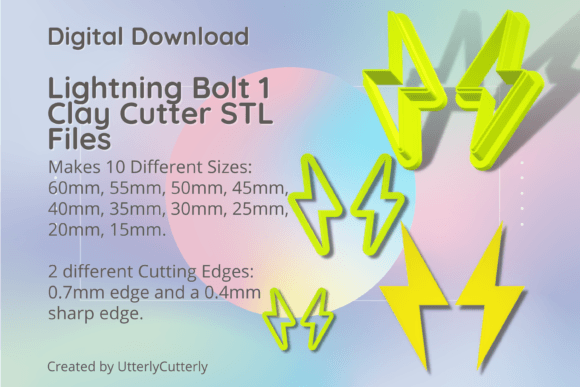
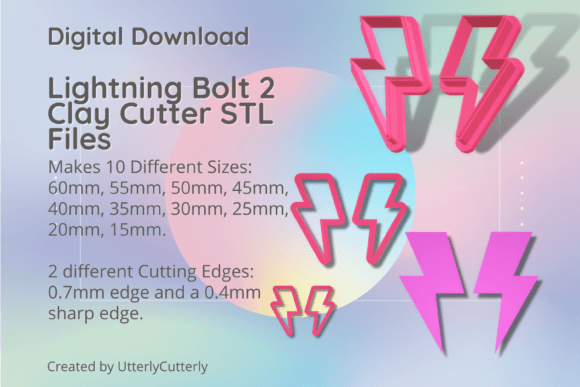
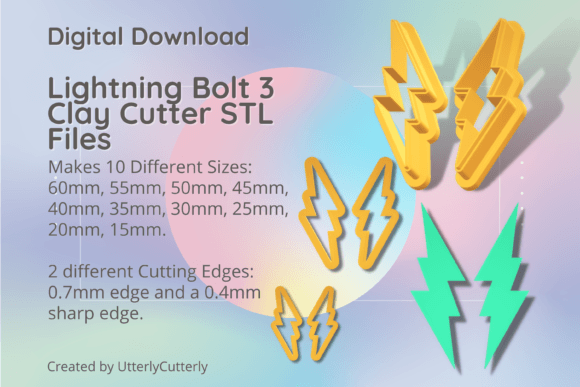
The Lightning Bolt 3 Clay Cutter - STL Digit bundle offers ten discrete sizes, ranging from 15mm to 60mm. This graduated scale is designed to facilitate nesting sets and proportional design systems rather than isolated single-item creation. Measurements are taken from the longest ends of the lightning bolt geometry, ensuring accurate spatial planning for your projects.
For jewelry designers, the included spectrum supports comprehensive earring curation. A typical graduated set might utilize the 60mm, 55mm, 50mm, 45mm, 40mm, 35mm, 30mm, 25mm, 20mm, and 15mm sizes to create visual rhythm within a collection. This systematic approach to sizing allows for efficient marketing photography and tiered pricing structures. Instead of treating each size as a separate SKU, consider how they interact visually. The ability to print exact intermediate sizes means you can fill gaps in existing product lines or create micro-collections that competitors using fixed-size commercial cutters cannot replicate.
Operational Considerations for Embossing and Depth
A critical technical constraint within the Lightning Bolt 3 Clay Cutter - STL Digit files relates to embossing functionality. If your selected design variant includes embossing lines, they are modeled at a height of 10.5mm. This dimension dictates your material preparation strategy. To achieve a clean impression without bottoming out or distorting the cutter base, your clay slab must be thicker than 1.5mm.
Failing to account for this clearance is a common operational error that leads to wasted material and inconsistent depth. Before beginning a production run involving embossed variants, calibrate your slab rollers or guide rings to ensure a minimum thickness of 2mm to provide a safety margin. This extra half-millimeter accommodates minor variations in clay density and ensures the embossed detail registers fully against the backing surface. For non-embossed cutting tasks, standard thickness guidelines apply, but maintaining awareness of this 10.5mm internal clearance prevents accidental damage to the cutter interior when working with thicker media.
Digital Asset Management and Print Optimization
Because this is a digital download and not a physical item, your responsibility shifts from inventory storage to file management and print validation. Upon payment confirmation, you receive immediate access to the STL files. Strategic makers treat these files as master assets. Organize them logically by size and edge type to prevent printing errors during high-pressure production windows. Misidentifying a Sharp Edge file as a Standard Edge file can lead to hours of wasted filament and unusable tools.
When slicing these files for production, prioritize bed adhesion and vertical layer strength. The 3mm base is substantial, but the thin cutting edges—particularly the 0.4mm SE variant—require careful orientation. Printing with the cutting edge facing up is generally recommended to avoid support structures on the functional surface. Use a brim if necessary to secure the base, but ensure it does not interfere with the flatness of the cutter’s footprint. Post-print, verify the dimensional accuracy of your first article against digital calipers before committing to a full batch. Printer calibration drift can alter the effective cutting size, potentially disrupting the precision required for interlocking designs or fitted components.
Mitigating Risks in Digital Tool Adoption
While the Lightning Bolt 3 Clay Cutter - STL Digit offers significant advantages, relying on digital fabrication introduces specific risks that must be managed proactively. The primary risk is over-reliance on a single printer or filament batch. If your production halts due to mechanical failure, you lose access to your tools. Mitigate this by maintaining a physical buffer stock of critical sizes or establishing a relationship with a local print service bureau as a backup.
Another consideration is intellectual property and licensing. Ensure you understand the terms associated with the digital download. Typically, STL files grant usage rights for physical products but prohibit redistribution of the digital asset itself. Clarifying these boundaries protects your business from legal exposure and respects the designer’s ecosystem. Furthermore, recognize that digital tools require ongoing maintenance. Nozzle wear, bed leveling issues, and material humidity can all degrade cutter quality over time. Implement a regular quality assurance check where test prints are measured and inspected for edge burrs before entering active rotation.
Integrating New Designs into Existing Workflows
The Lightning Bolt 3 Clay Cutter - STL Digit is part of a broader ecosystem, with new STL files added to the store weekly. This continuous release cycle presents both opportunity and challenge. Strategically, it allows for rapid trend responsiveness. However, indiscriminately adding new shapes can dilute your brand identity and complicate inventory management.
Approach new releases with a filtering framework. Before downloading or purchasing additional bundles, evaluate them against three criteria: production compatibility, market demand, and differentiation potential. Does the new shape nest well with your existing lightning bolt sizes? Can it be produced using your current clay conditioning setup without retooling? Does it solve a specific customer pain point or open a new revenue stream? By applying this strategic filter, you transform digital collecting into curated assortment planning. This intentionality ensures that every file in your library serves a defined purpose in your business model, preventing digital clutter and focusing resources on assets that drive tangible outcomes.
Ultimately, the Lightning Bolt 3 Clay Cutter - STL Digit is a precision instrument for modern makers. Its value is realized not merely through ownership, but through thoughtful integration into a disciplined creative practice. By mastering the technical distinctions between edge profiles, respecting dimensional constraints for embossing, and managing digital assets with the same rigor as physical inventory, you leverage this tool to build a more resilient, responsive, and distinctive making business.