Lantern 3 Clay Cutter: Technical Specifications and Creative Applications for Vintage Designs
The intersection of traditional craftsmanship and modern additive manufacturing has created new possibilities for artisans working with polymer clay, ceramic dough, and cookie mediums. Central to this evolution is the availability of high-precision digital assets, such as the Lantern 3 Clay Cutter - Vintage Lantern STL bundle. This digital download provides makers with immediate access to professionally engineered cutting tools that replicate intricate, ornate lantern shapes from historical aesthetics. Unlike generic mass-produced cutters, these files are optimized specifically for FDM (Fused Deposition Modeling) printing, ensuring that the final physical tool performs reliably across various material densities.
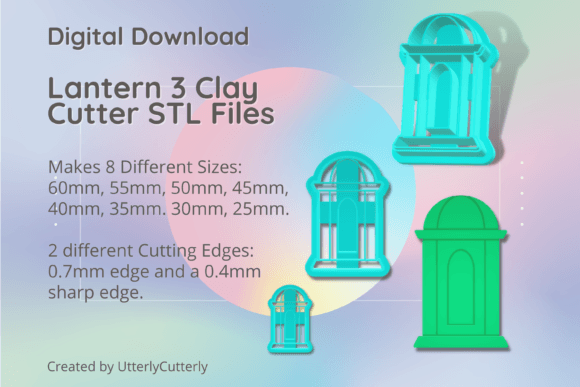
Understanding the technical architecture of these STL files is essential for achieving professional results. The Lantern 3 Clay Cutter collection is not merely a shape outline; it is a parametrically designed system comprising eight distinct sizes and two specialized edge profiles. This versatility allows creators to curate custom cutter combinations that suit specific project requirements, whether producing miniature jewelry components or larger decorative confections. By leveraging these digital files, users eliminate shipping wait times and gain the autonomy to produce replacement tools or scale variations on demand.
Dual Edge Profiles for Material Versatility
A critical consideration when selecting or printing clay cutters is the relationship between the blade geometry and the medium being manipulated. The Lantern 3 Vintage Lantern pack addresses this by offering two distinct cutter types within the same digital bundle. Recognizing that polymer clay behaves differently than shortbread dough or porcelain slip, having multiple edge options ensures clean releases and defined edges regardless of the application.
Standard Precision Edge Configuration
The first profile included in the STL set features a robust construction designed for general-purpose use and durability. This variant possesses a 0.7mm wall thickness paired with a 0.7mm cutting edge. While slightly thicker than a razor blade, this dimension offers significant structural integrity during the printing process and subsequent use. It is particularly effective for firmer clays or materials that require more force to penetrate without distorting the cutter shape. The base measures 3mm thick with a total height of 12mm, providing ample surface area for finger pressure while maintaining a low center of gravity to prevent rocking during impression.
Sharp Edge (SE) Variant for Fine Detail
For applications requiring surgical precision, the bundle includes the Sharp Edge variant, abbreviated as SE in the file nomenclature. This design utilizes a 1mm support wall that tapers down to an aggressive 0.4mm cutting edge. This reduced contact area significantly decreases friction, allowing the cutter to glide through softer polymer clays and fondant with minimal drag. The sharper angle produces crisper definitions on the vintage lantern filigree, which is vital when capturing the ornate nature of the design. Like the standard version, the SE cutter maintains the 3mm base and 12mm height specifications, ensuring ergonomic consistency across the entire product line.
Dimensional Hierarchy and Scaling Logic
Professional curation often relies on proportional relationships between elements. A single size rarely suffices for complex compositions involving layering, stacking, or graduated patterns. The Lantern 3 Clay Cutter digital pack addresses this need through a comprehensive sizing matrix. Measurements are derived from the longest ends of the cutter to ensure accurate spatial planning on work surfaces.
- 60mm: Ideal for statement pieces, large cookie centers, or primary focal points in mixed-media art.
- 55mm and 50mm: Versatile mid-range sizes suitable for standard pendants, ornaments, and decorative tiles.
- 45mm and 40mm: Optimal for earring components, charm bracelets, and secondary design elements.
- 35mm, 30mm, and 25mm: Specialized micro-sizes for stud earrings, ring faces, and intricate accent details.
This graduated scaling allows makers to mix and match within the Lantern 3 ecosystem or combine these files with other STL assets from the store. Because new designs are added weekly, maintaining consistent sizing logic across different cutter packs enables seamless integration. For example, a 40mm vintage lantern might pair perfectly with a 40mm floral frame from a separate collection, facilitating modular design workflows that would be impossible with inconsistently sized commercial cutters.
Additive Manufacturing Optimization and Print Parameters
Since this product is a digital download rather than a physical item, the quality of the final tool depends entirely on the user’s printing parameters. These STL files have been tested and validated for printability, but achieving the intended tolerances requires appropriate slicer configuration. The 12mm height and 3mm base dimensions are engineered to balance print speed with functional rigidity.
When printing the Sharp Edge (SE) variants, nozzle diameter becomes a limiting factor. A 0.4mm nozzle is generally recommended as the maximum size for the SE cutting edge to ensure the taper forms correctly. Users with 0.6mm nozzles may find the standard 0.7mm edge variant yields better results, as the sharp edge may print as a blunt wall if the extrusion width exceeds the designed tip geometry. Layer height also plays a role; 0.12mm to 0.16mm layers typically provide sufficient resolution for the ornate lantern details without extending print times unnecessarily.
Adhesion is another practical consideration. The 3mm thick base provides adequate footprint for bed adhesion, reducing the risk of warping or detachment during printing. However, because these cutters feature internal voids and thin walls, cooling fan management is crucial. Insufficient cooling can cause the thin cutting edges to deform or fuse, while excessive cooling too early in the print may compromise layer bonding at the base. Following the tested parameters associated with these files ensures that the digital design translates accurately into a functional physical tool.
Embossing Compatibility and Material Thickness
Beyond simple outline cutting, the Lantern 3 Clay Cutter system incorporates embossing functionality for enhanced surface texture. Files containing embossing lines are engineered with specific depth tolerances that interact directly with material volume. The embossing features stand 10.5mm tall relative to the base, leaving a precise clearance within the 12mm total cutter height.
This dimensional specification dictates a minimum material threshold. For the embossing lines to register clearly without bottoming out or causing sticking issues, the clay or dough must be conditioned to a thickness greater than 1.5mm. Working with material thinner than this specification risks incomplete impressions or structural failure of the impressed piece. Conversely, materials significantly thicker than the embossing depth will still function for cutting, but the internal detail may become submerged or indistinct. Understanding this 1.5mm floor allows creators to prepare their slabs appropriately before engaging with the cutter, preventing wasted material and frustration.
Workflow Integration for Digital Asset Management
Acquiring the Lantern 3 Clay Cutter - Vintage Lantern as an STL file shifts the production workflow from procurement to fabrication. This model offers distinct advantages for business owners and educators who require scalable resources. Upon completion of payment, immediate access to the download eliminates supply chain latency. This instant availability supports just-in-time production models where tools are manufactured only as needed for specific commissions or curriculum modules.
Furthermore, digital ownership facilitates archival preservation and iteration. Physical plastic cutters degrade over time, losing sharpness or breaking under stress. With the source STL file, a maker can reprint a fresh, sharp cutter whenever wear affects performance. This sustainability aspect reduces long-term waste and cost. Additionally, the ability to test print at different scales or modify slicing parameters allows for experimentation that physical products cannot offer. Whether adjusting infill density for a lighter cutter or modifying wall counts for extra strength, the digital format empowers users to tailor the tool to their unique tactile preferences and mechanical constraints.
Cross-Disciplinary Utility and Safety Considerations
While primarily marketed toward clay artists, the geometric precision of the Lantern 3 Vintage Lantern cutter extends to adjacent fields. Researchers and educators utilizing tactile learning aids can produce consistent, repeatable shapes for sensory studies or historical artifact replication. In culinary arts, the food-safe potential of printed tools depends entirely on the filament choice and post-processing sealing; however, the geometric accuracy remains valuable for fondant work and pastry decoration where visual fidelity to vintage aesthetics is paramount.
Safety in usage correlates directly to print quality. A poorly printed cutter with layer separation or rough edges can harbor bacteria or snag delicate materials. Users should inspect every printed tool for defects before use, particularly along the cutting edge and embossing lines. Sanding or coating printed parts with food-safe epoxy is recommended for any application involving consumables. For polymer clay and non-food crafts, deburring the cutting edge with fine sandpaper can enhance performance and protect hands during extended studio sessions. By treating the digital file as a blueprint rather than a finished product, makers assume responsibility for quality assurance, resulting in tools that meet professional standards for safety and efficacy.