Hexagon Combo 3 Clay Cutter - Geometric STL Evaluation
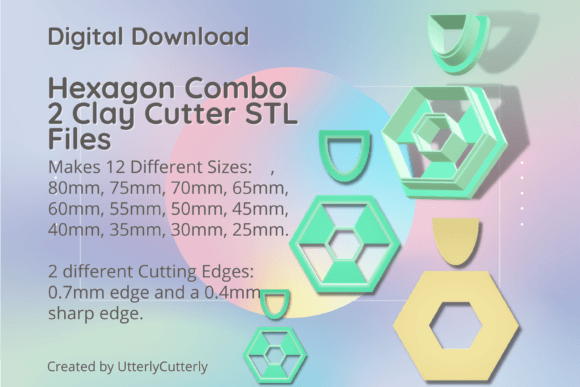
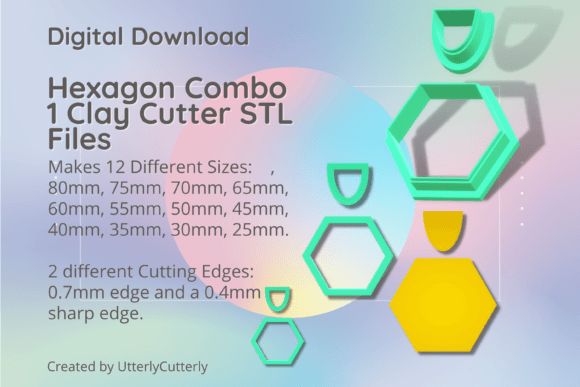
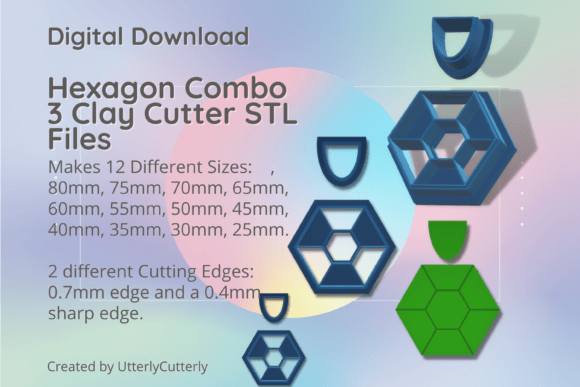
The Hexagon Combo 3 Clay Cutter - Geometric is a digital product consisting of STL files designed for 3D printing. This specific bundle focuses on geometric hexagonal shapes intended for use with polymer clay, ceramic clay, or cookie dough. Unlike physical tools shipped via mail, this product provides immediate access to twelve distinct size variations and two unique cutting edge profiles. For makers who own FDM or resin 3D printers, this digital format offers a method to produce custom shaping tools on demand without waiting for manufacturing or shipping lead times.
Understanding the Digital Format and Utility
Evaluating this product requires understanding that it is strictly a digital asset. Upon purchase, users receive downloadable files rather than a tangible cutter. The primary value proposition lies in the versatility of the STL format. Users can print as many copies as needed, replace broken tools instantly, or adjust printer settings to suit specific material requirements. The Hexagon Combo 3 Clay Cutter - Geometric serves as a foundational shape library. Hexagons are frequently used in tessellating patterns, modern jewelry design, and structured cookie sets. Having twelve incremental sizes allows for precise nesting and scaling that pre-manufactured plastic cutters rarely offer.
The utility extends beyond simple cutting. Because these files are digital, they integrate into a broader workflow. Makers can curate custom combos by pairing this hexagon set with other geometric STL files from the same ecosystem. New designs are added weekly, suggesting an expanding compatibility for those building a comprehensive digital tool library. However, this utility is contingent upon the user possessing a calibrated 3D printer and the technical knowledge to slice and print functional mechanical parts.
Analyzing Cutting Edge Profiles and Specifications
A critical decision point when using the Hexagon Combo 3 Clay Cutter - Geometric is selecting between the two included edge types. The bundle provides both a standard wall version and a Sharp Edge (SE) version. Understanding the tradeoffs between these profiles is essential for achieving desired results.
- Standard Wall (0.7mm): This profile features a 0.7mm wall thickness with a 3mm thick base and a total height of 12mm. It offers higher durability and rigidity during the printing process. This edge is suitable for general-purpose cutting where extreme sharpness is less critical than tool longevity. It is often easier to print successfully on standard FDM machines without specialized nozzle configurations.
- Sharp Edge (SE): Abbreviated as SE in the file names, this variant includes a 1mm support wall tapering to a 0.4mm cutting edge. Like the standard version, it has a 3mm base and 12mm height. The thinner edge provides cleaner cuts through polymer clay and reduces drag, resulting in less distortion of the workpiece. However, the 0.4mm tip is more fragile and may require slower print speeds, lower layer heights, or a hardened steel nozzle to prevent wear or clogging.
Both cutter types share identical base dimensions and overall height, ensuring consistency across the set regardless of the edge profile chosen. The sizing is measured from the longest ends, ranging systematically from 25mm up to 80mm in 5mm increments. This graduated sizing facilitates efficient material usage and allows for proportional design work.
Technical Considerations for Printing and Use
Prospective users must evaluate their equipment capabilities before acquiring the Hexagon Combo 3 Clay Cutter - Geometric. While the files are designed to be easily printed, "easy" is relative to printer calibration. Thin-walled objects like clay cutters are sensitive to flow rate inconsistencies and cooling issues. The 0.7mm wall version generally prints reliably with a 0.4mm nozzle, but the SE version may benefit from a 0.25mm nozzle for optimal definition.
Material selection also influences performance. PLA is the most common choice due to its stiffness and ease of printing, but it can be brittle. PETG or ABS may offer better flexibility and durability for repeated use, though they present greater printing challenges regarding stringing and shrinkage. Users should anticipate test prints to dial in retraction and cooling settings specifically for thin vertical walls.
Regarding application, users should note the embossing specifications. If utilizing files with embossing lines, the relief height is 10.5mm. This necessitates working with clay slabs thicker than 1.5mm to ensure the impression registers clearly without bottoming out. Attempting to use embossing features on thin sheets will result in poor definition and potential sticking. This specification makes the cutters better suited for jewelry components and substantial cookies rather than delicate veneers.
Situational Fit and Alternative Options
The Hexagon Combo 3 Clay Cutter - Geometric represents a strong fit for specific user profiles. It is ideal for makers who already own a 3D printer and wish to minimize per-unit tool costs over time. It is also advantageous for designers requiring non-standard sizes or immediate replacement capability. The ability to print a fresh cutter mid-project eliminates downtime associated with breakage or loss.
Conversely, alternatives may be worth considering for users without 3D printing infrastructure. Purchasing a physical brass or stainless steel cutter may have a higher upfront cost but offers superior edge retention and zero maintenance. Metal cutters do not suffer from layer lines, which can sometimes transfer texture to soft clay. Additionally, users who require food-safe certification for commercial baking should verify that their chosen filament and printer setup meet safety standards, as standard 3D printed plastics are generally not certified food-safe due to bacterial harboring in layer gaps.
For hobbyists who only need one or two hexagon sizes, buying individual physical cutters remains more economical than investing in printer maintenance and filament solely for this pack. The digital route becomes cost-effective primarily at volume or when integrated into a larger digital fabrication workflow.
Making an Informed Decision
Selecting the Hexagon Combo 3 Clay Cutter - Geometric involves weighing the convenience of digital ownership against the responsibilities of self-manufacturing. All cutters in this collection are tested prior to sale, providing a baseline assurance of printability. However, successful outcomes depend heavily on local machine tuning. Buyers should view this product as a blueprint for tool creation rather than a finished good.
When evaluating this bundle, consider your current project pipeline. If you regularly create geometric jewelry or structured baked goods, the twelve-size range provides significant creative latitude. If your needs are sporadic, the setup time for printing may outweigh the benefits. Ultimately, this STL pack serves as a practical resource for technically inclined makers seeking precision, customization, and autonomy in their clay or cookie crafting processes.