Hexagon Combo 2 Clay Cutter - Geometric STL Evaluation
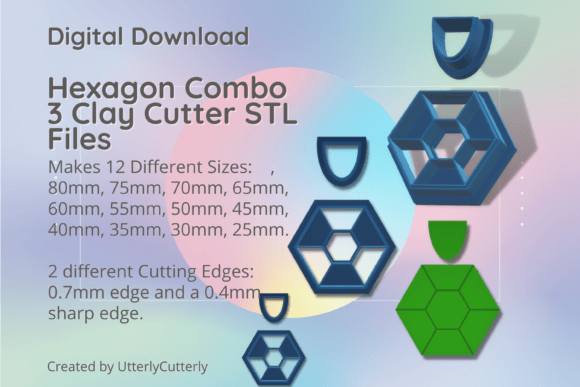
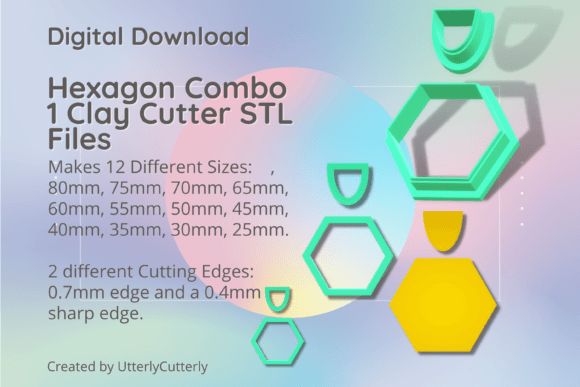
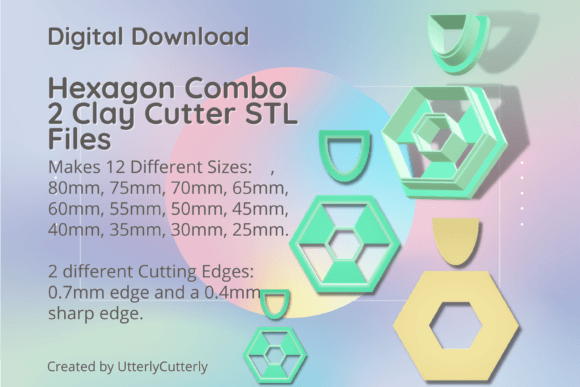
The Hexagon Combo 2 Clay Cutter - Geometric is a digital asset package containing STL files designed for FDM and resin 3D printing. This specific bundle focuses on geometric precision, offering twelve distinct sizes of hexagonal cutters alongside two specialized cutting edge profiles. Unlike physical tools shipped from a manufacturer, this product provides the source data required to fabricate custom clay shaping tools locally. The collection targets polymer clay artists, ceramicists, and cookie decorators who require consistent geometric forms across varying scales.
Evaluating this digital download requires understanding both the technical specifications of the files and the practical application of the resulting printed tools. Because the utility of this product depends entirely on the user's ability to print and post-process the models accurately, potential buyers must assess whether their current hardware and workflow align with the design parameters outlined in this pack.
Technical Specifications and Design Variants
The core value of the Hexagon Combo 2 lies in its dual-profile approach. Rather than offering a single blade type, the STL pack includes two distinct variations optimized for different materials and finishing requirements. Understanding the difference between these profiles is essential for selecting the correct file for a specific project.
- Standard Profile (0.7mm Wall): This variant features a 0.7mm wall thickness with a 3mm thick base and a total height of 12mm. The wider wall provides structural rigidity, making it suitable for firmer clays or repetitive use where tool flex might distort the shape. However, the thicker edge leaves a more pronounced ridge on the clay that may require additional smoothing.
- Sharp Edge (SE) Profile: Abbreviated as SE in the file names, this version utilizes a 1mm support wall tapering to a 0.4mm cutting edge. It shares the same 3mm base and 12mm height as the standard profile. The reduced contact surface area allows for cleaner cuts with less material displacement, which is particularly beneficial for soft polymer clays or detailed cookie doughs where drag marks are undesirable.
The size range spans from 25mm to 80mm, measured from the longest ends of the hexagon. The twelve included sizes (25mm, 30mm, 35mm, 40mm, 45mm, 50mm, 55mm, 60mm, 65mm, 70mm, 75mm, and 80mm) provide a comprehensive gradient for creating nested designs, graduated jewelry sets, or tiered confectionery displays. Users should note that if embossing lines are present in specific design variations within the combo, they are set at 10.5mm tall. Consequently, these embossing features will only register effectively on clay slabs thicker than 1.5mm.
Hardware Requirements and Printability
As a digital download, the performance of the Hexagon Combo 2 Clay Cutter - Geometric is contingent upon local manufacturing capabilities. Prospective users must evaluate their 3D printer’s resolution before purchase. While the files are designed to be easily printed, the 0.4mm cutting edge of the SE variant approaches the lower limit of reliable extrusion for many standard FDM printers.
Printers with 0.4mm nozzles can produce these tools, but optimal results typically require tuning retraction settings and cooling fans to prevent blobbing on the thin walls. Resin printers generally achieve superior edge definition for the SE profile due to higher XY resolution, though the standard 0.7mm profile prints reliably on most entry-level FDM machines. Users without access to a calibrated 3D printer or those unwilling to perform test prints and calibration may find the learning curve steep. In such cases, purchasing pre-manufactured metal or plastic cutters eliminates the variable of print quality entirely.
Material Compatibility and Application Fit
Determining whether this STL pack fits your workflow involves analyzing the primary medium you work with. The versatility of having two edge types makes this combo adaptable, but neither profile is universally perfect for every material.
Polymer Clay and Jewelry Making
For jewelry makers, the Sharp Edge (SE) profile is often the superior choice. Polymer clay is sensitive to drag, and a thinner edge reduces the amount of cleanup required after cutting. The 12mm height accommodates conditioning and stacking, while the 3mm base offers enough surface area for finger pressure without causing hand fatigue during long production runs. The smaller sizes (25mm–45mm) are specifically relevant for earring components and pendant bases.
Ceramics and Pottery
Ceramic clay bodies are denser and more abrasive than polymer. For wheel-thrown or slab-built ceramics, the Standard 0.7mm profile is generally recommended. The SE profile’s thin edge may degrade faster when used with groggy stoneware or porcelain. The larger sizes in this combo (60mm–80mm) are better suited for ceramic applications, such as creating uniform tiles, coasters, or modular vessel components.
Baking and Confectionery
While marketed primarily as clay cutters, the geometry is applicable to baking. Food safety considerations are paramount here; 3D printed tools have layer lines that can harbor bacteria. If using these files for cookies or fondant, users must apply a food-safe epoxy coating or use the printed cutter solely as a template for hand-cutting. The Sharp Edge profile produces cleaner edges on dough, reducing spreading during baking.
Evaluating Value Against Physical Alternatives
When comparing the Hexagon Combo 2 Clay Cutter - Geometric STL pack to physical alternatives, several tradeoffs emerge. Metal cutters offer durability and immediate usability but lack customization. Plastic commercial cutters are inexpensive but rarely offer twelve precise size increments or interchangeable edge profiles.
The primary advantage of this digital bundle is cost-efficiency at scale. Printing twelve cutters costs a fraction of buying twelve individual metal tools. Furthermore, the ability to reprint a damaged tool or adjust slicing parameters (such as increasing infill for strength or altering wall count) provides long-term utility that static physical tools cannot match. New STL files are added to the store weekly, allowing users to expand their geometric library incrementally rather than investing in large, expensive physical sets upfront.
However, the time investment is significant. Slicing, printing, removing supports, and sanding twelve cutters requires hours of labor. For hobbyists who enjoy the fabrication process, this is a feature. For professionals with high hourly rates or tight deadlines, the time-to-utility ratio may favor purchasing ready-made tools. Additionally, dimensional accuracy in 3D printing can vary by +/- 0.2mm depending on shrinkage compensation settings. Users requiring industrial-grade tolerances for mechanical parts may find 3D printed cutters insufficient, though they remain adequate for most artistic and culinary applications.
Decision-Making Checklist
To determine if the Hexagon Combo 2 Clay Cutter - Geometric is the right acquisition, consider the following practical factors:
- Printer Capability: Can your printer reliably reproduce 0.4mm walls? If not, are you satisfied using only the 0.7mm standard profile?
- Size Relevance: Do the specific 5mm increments between 25mm and 80mm align with your current project dimensions? If you primarily work outside this range, the utility diminishes.
- Post-Processing Willingness: Are you prepared to sand cutting edges to ensure smoothness? Printed layers can leave texture on clay unless finished properly.
- Clay Thickness: If you intend to use embossing features, do you consistently roll clay thicker than 1.5mm? Thinner sheets will not capture the detail.
- Digital Ownership: Are you comfortable managing STL files and maintaining a digital library? This is a non-refundable digital good once accessed.
Ultimately, this STL pack serves makers who prioritize customization and self-sufficiency over convenience. It bridges the gap between generic craft supplies and bespoke tooling, provided the user possesses the technical infrastructure to realize the digital designs physically. By carefully weighing the edge profiles against your specific material needs and assessing your printing capacity, you can determine if this geometric combo enhances your creative toolkit or represents an unnecessary complexity.