Hexagon Combo 1 Clay Cutter - Geometric: Evaluating Digital STL Options for Polymer Clay and Baking
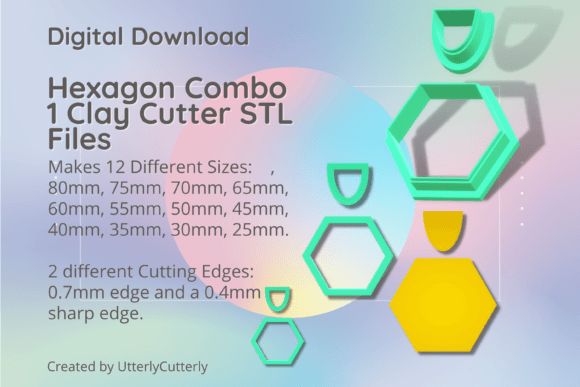
For makers working with polymer clay, ceramic dough, or cookie icing, the transition from physical tools to digital fabrication offers significant advantages in customization and cost-efficiency. The Hexagon Combo 1 Clay Cutter - Geometric represents a specific category of digital manufacturing resources: a downloadable STL file bundle designed for FDM (Fused Deposition Modeling) 3D printing. Unlike traditional metal cutters or single-size plastic options purchased from craft stores, this digital asset provides twelve distinct sizes and two specialized cutting edge profiles within a single package. Understanding the technical specifications and practical applications of this geometric set is essential for determining whether it aligns with your current production workflow or if alternative tooling methods would be more suitable.
Digital Versus Physical Tooling: Assessing the Tradeoffs
When evaluating the Hexagon Combo 1 Clay Cutter - Geometric against standard retail alternatives, the primary distinction lies in the acquisition model and material control. Physical brass or stainless steel cutters offer superior durability and heat resistance, making them the industry standard for high-volume commercial baking or professional ceramic studios where tools undergo thousands of cycles. However, they lack size flexibility; purchasing a full gradient of hexagonal sizes in metal can be prohibitively expensive and storage-intensive.
In contrast, this STL bundle shifts the manufacturing responsibility to the user. The tradeoff for lower upfront cost and immense variety is the requirement for 3D printing hardware and post-processing time. This format is ideal for hobbyists, small-batch jewelry designers, and educators who need specific dimensions on demand but do not require industrial-grade longevity. If your work involves abrasive materials like grog-heavy clay or requires sterilization at high temperatures, printed PLA or PETG cutters may degrade faster than metal. However, for polymer clay jewelry, fondant, or soft cookie dough, the lifespan of a well-printed geometric cutter is typically sufficient for extensive use.
Analyzing Edge Profiles: Standard Wall vs. Sharp Edge
A critical decision factor within the Hexagon Combo 1 Clay Cutter - Geometric pack is the inclusion of two distinct cutter types. Selecting the correct profile depends entirely on the medium you are manipulating and the desired finish of the final piece.
The 0.7mm Wall Profile
This version features a 0.7mm wall thickness, a 3mm base, and a 12mm height. It is engineered for structural rigidity and ease of printing. Because the cutting edge matches the wall thickness, this profile is less likely to warp during the printing process and is more forgiving regarding nozzle calibration. It is best suited for:
- Cookies and Baking: The thicker edge prevents dough from sticking inside the cutter and provides enough surface area to grip when lifting.
- Soft Clays and Fondant: Prevents excessive deformation of softer mediums that might occur with razor-thin edges.
- Beginner Printers: Users still dialing in their flow rate or bed adhesion will find this geometry more reliable.
The Sharp Edge (SE) Profile
Abbreviated as SE in the file names, this variant utilizes a 1mm support wall tapering to a precise 0.4mm cutting edge. While more challenging to print successfully, it offers distinct functional benefits for detailed work. The reduced contact area minimizes drag, resulting in cleaner cuts with less distortion. This profile is specifically recommended for:
- Polymer Clay Jewelry: Creates crisp edges that require minimal sanding or trimming after baking.
- Firm Materials: Cuts through conditioned polymer clay or marzipan without compressing the shape.
- Advanced Users: Requires optimal printer tuning to avoid fragile edges that may snap during removal from the build plate.
Size Gradation and Project Scalability
Geometric design often relies on nesting, layering, or creating visual rhythm through repetition. The Hexagon Combo 1 Clay Cutter - Geometric addresses this by providing a comprehensive size range from 25mm to 80mm in 5mm increments. This systematic gradation allows for precise scaling that is rarely available in off-the-shelf sets.
For jewelry makers, the smaller spectrum (25mm–45mm) facilitates the creation of earring components, pendants, and charm clusters where proportional consistency is vital. The larger sizes (50mm–80mm) serve architectural purposes in mixed media art, large-scale cookie decorating, or ceramic tile work. When comparing this to buying individual cutters, the digital bundle eliminates the guesswork of sourcing matching shapes across different vendors. However, users should note that cutter size is measured from the longest ends; verifying your specific project requirements against these outer dimensions before printing is necessary to avoid material waste.
Technical Considerations for Embossing and Printing
Beyond simple outline cutting, this digital resource includes embossing capabilities. Any embossing lines within the files are designed at a height of 10.5mm. This specification carries important implications for material preparation. To achieve a clear impression without bottoming out or tearing the material, users must condition their clay to a thickness greater than 1.5mm. Attempting to use these embossers on thin sheets will result in poor definition and potential damage to the printed tool.
Furthermore, while the files are tested prior to release, print success varies based on hardware. The 12mm uniform height across all sizes provides stability, but the sharp edge variants may require brims or rafts depending on your printer’s bed adhesion. Users should evaluate their own machine's capabilities honestly; if your printer struggles with fine details or overhangs, the standard 0.7mm wall files will yield better results than forcing the SE versions.
Integration with Existing Digital Libraries
One of the strategic advantages of adopting STL-based tools like the Hexagon Combo 1 Clay Cutter - Geometric is interoperability. Unlike proprietary physical systems, digital files allow for modular curation. Makers can combine this hexagon set with other geometric packs, texture stamps, or custom-designed handles to create a bespoke toolkit tailored to evolving trends. New STL files are added to the ecosystem weekly, enabling continuous expansion without physical inventory constraints.
This approach favors adaptable creators who view their tools as fluid assets rather than static purchases. However, it also demands organizational discipline. Managing dozens of STL files, tracking which edge profile works best for specific clays, and maintaining printer calibration requires a level of technical engagement that traditional crafting does not. For those willing to manage this overhead, the creative ceiling is significantly higher.
Determining Fit: When to Choose Digital Over Traditional
Selecting the right tooling solution requires an honest assessment of your production environment and goals. The Hexagon Combo 1 Clay Cutter - Geometric is likely the appropriate choice if you possess a functioning 3D printer, value size versatility over extreme durability, and work primarily with non-abrasive mediums like polymer clay or food products. It is particularly valuable for designers experimenting with geometric patterns who cannot justify the expense of custom metal tooling for every new concept.
Conversely, readers should consider alternative options if they lack access to 3D printing infrastructure, require tools for high-temperature ceramics, or produce goods at a commercial scale where tool failure would disrupt business operations. In such cases, investing in machined metal cutters or outsourcing production may offer better long-term value despite the higher initial cost. Ultimately, this digital bundle serves as a flexible, low-risk entry point into precision geometric shaping, provided the user approaches it with realistic expectations regarding the intersection of digital fabrication and handcraft.