Bottle 1 Clay Cutter STL: Digital File Guide
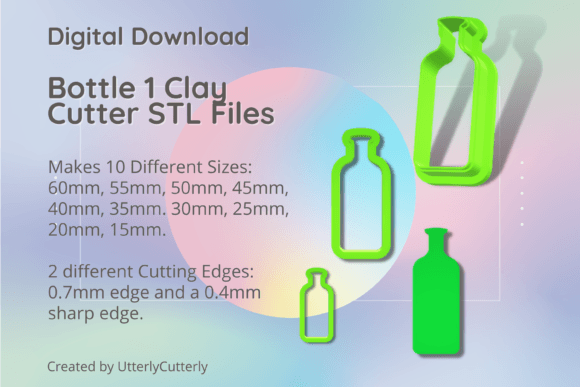
Creating consistent, professional-grade polymer clay jewelry or detailed cookie designs requires more than just steady hands; it demands precision tools that bridge the gap between digital design and physical craft. The Bottle 1 Clay Cutter - STL Digital File represents a shift toward accessible, high-quality fabrication for independent makers. Rather than relying on mass-produced metal cutters with limited shape options, this digital asset allows designers and hobbyists to manufacture their own bespoke tooling on demand. The visual character of this specific bottle silhouette strikes a balance between classic apothecary aesthetics and modern minimalism, making it an essential addition to any digital library of design assets.
This STL file is not merely a shape; it is a calibrated instrument designed for specific material behaviors. Whether you are curating a cohesive brand identity for a jewelry line or developing packaging design prototypes in clay, having immediate access to scalable, tested geometry ensures your output remains professional. For creators who treat their craft as a business, the ability to iterate on size and edge profile without waiting for shipping transforms how quickly you can respond to trends or client requests.
Technical Specifications and Print Optimization
The true value of any premium font or functional 3D model lies in its technical execution. A poorly constructed typeface suffers from rendering issues on screen; similarly, a poorly engineered clay cutter fails during the impression phase. This bundle addresses those friction points by offering two distinct cutting profiles tailored to different stages of production and material types. Understanding these variations is critical for achieving clean edges and preserving fine details in your final piece.
- Standard Wall Profile: Features a 0.7mm wall thickness with a 3mm thick base and a total height of 12mm. This robust configuration provides structural rigidity during printing and use, making it ideal for stiffer clays or when significant downward pressure is required. The wider wall also helps prevent distortion in softer materials.
- Sharp Edge (SE) Profile: Abbreviated as SE in the file set, this variant utilizes a 1mm support wall tapering to a precise 0.4mm cutting edge. With the same 3mm base and 12mm height, this profile mimics the performance of traditional metal cutters. It excels at slicing through conditioned polymer clay with minimal resistance, reducing drag marks and ensuring crisp boundaries for intricate logo design or editorial elements.
Both profiles share a standardized 12mm height, which serves a dual purpose. It provides ample surface area for gripping while ensuring compatibility with standard clay conditioning depths. If your design workflow includes embossing lines, note that they are modeled at 10.5mm tall. This intentional offset requires a clay sheet thicker than 1.5mm to capture the full depth of the texture without bottoming out, a crucial consideration for layered branding or tactile packaging design experiments.
Strategic Sizing for Visual Hierarchy
In typography, selecting the right point size establishes readability and emphasis. In physical crafting, cutter size dictates composition and scale. This bundle includes ten graduated sizes ranging from 60mm down to 15mm in 5mm increments. This granular scaling allows makers to establish a clear visual hierarchy within a single collection. A 60mm cutter might serve as the primary focal point for a statement necklace or large cookie, while the 20mm and 15mm variants function as accent elements or charms.
Having this range available in a single digital download eliminates the guesswork often associated with sourcing individual tools. For small business owners managing inventory, this versatility means one master shape can generate an entire product family. You can create matching sets where the proportion remains mathematically consistent across all sizes, reinforcing brand recognition and professionalism. When evaluating project fit, consider testing multiple sizes in scrap material first to understand how the specific bottle silhouette translates at smaller scales, as some curves may require adjustment in your post-processing workflow depending on the chosen size.
Applications Across Creative Disciplines
While primarily marketed for clay and confectionery, the utility of the Bottle 1 Clay Cutter extends into broader creative and commercial contexts. Makers operating at the intersection of digital and analog workflows find these files particularly valuable for rapid prototyping and mixed-media projects.
Jewelry Design and Brand Identity: For artisans building a signature style, consistency is paramount. Using the same STL-derived cutter across earring studs, pendants, and ring blanks creates a unified visual language. The Sharp Edge variant is especially useful here, as clean cuts reduce sanding time and preserve the integrity of color gradients in translucent or mica-shifted clays. This level of finish signals quality to customers and elevates the perceived value of handmade goods.
Editorial and Content Creation: Bloggers and social media content creators often need physical props that align with digital themes. Printing custom cutters allows for the creation of branded clay elements for flat lays, stop-motion animation, or tutorial content. Because new STL files are added to the store weekly, creators can maintain a fresh aesthetic without accumulating physical storage clutter. The digital nature of these assets supports a sustainable, on-demand production model that appeals to eco-conscious audiences.
Packaging and Product Development: Designers exploring tactile packaging concepts can use these cutters to prototype embossed seals, wax stamps, or clay tags. The 10.5mm embossing depth capability allows for testing how light interacts with raised surfaces before committing to expensive industrial tooling. This makes the Bottle 1 STL a cost-effective bridge between conceptual design and manufacturing validation.
Best Practices for Digital Asset Management
Treating STL files with the same organizational rigor as premium fonts or vector logos streamlines your creative process. Since this is a digital download rather than a physical item, establishing a logical file structure prevents version confusion. We recommend organizing folders by shape name, then by edge type (Standard vs. SE), and finally by size. This mirrors how professional designers manage typeface families and ensures you can locate the exact specification needed mid-project.
When integrating these cutters into a commercial workflow, always verify your printer’s tolerances. While our cutters are tested before being sold as part of our quality assurance protocol, individual machine calibration varies. Print a test square or calibration cube alongside your first bottle cutter to confirm dimensional accuracy. If you plan to sell items made with these tools, review the licensing terms associated with the digital file to ensure compliance for commercial font and asset usage. Just as you would verify the license for a display font used in a logo, confirming the rights for 3D printed tools protects your business legally and ethically.
Ultimately, the Bottle 1 Clay Cutter - STL Digital File offers more than just a shape; it provides a foundation for scalable, professional craftsmanship. By leveraging the precision of digital fabrication, makers can focus less on tool limitations and more on artistic expression and brand development. Whether you are producing a limited-edition jewelry capsule or designing interactive workshop materials, having reliable, versatile, and instantly accessible tooling empowers you to execute your vision with confidence and consistency.