Slim Rectangle Combo 1 Geo Clay Cutter STL Files
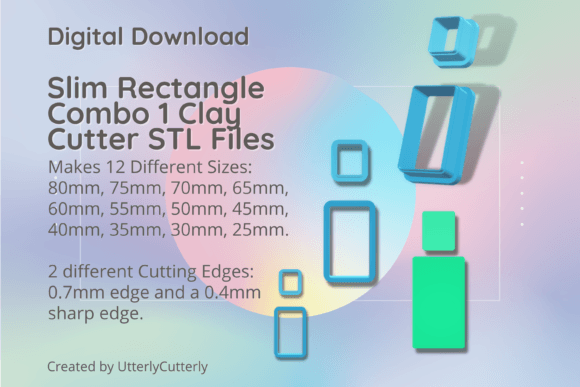
The Slim Rectangle Combo 1 Clay Cutter - Geo is a comprehensive digital download package designed for makers who require precision and versatility in their geometric designs. Rather than purchasing individual physical tools, this bundle provides immediate access to high-quality STL files optimized for 3D printing. The collection focuses on the fundamental rectangle shape but offers significant variation through twelve distinct sizes and two specialized cutting edge profiles. This digital-first approach allows polymer clay artists, cookie decorators, and jewelry makers to produce custom tools on demand, eliminating shipping wait times and enabling rapid iteration of design concepts.
Digital Flexibility for Diverse Creative Needs
Different creators prioritize different aspects of tool performance, and a digital file set accommodates these varying needs better than static physical products. For a professional jeweler, consistency across multiple production runs is paramount. Having the source file means that if a cutter breaks or wears down after months of heavy use, an identical replacement can be printed in under an hour. Conversely, a hobbyist exploring new techniques might value the low barrier to entry; there is no need to commit to expensive inventory before knowing if a specific size suits their style.
Educators and workshop leaders often face budget constraints when outfitting classrooms or group sessions. With the Slim Rectangle Combo 1 Clay Cutter - Geo, the cost per unit drops significantly once the initial file is acquired. A teacher can print dozens of cutters for the price of filament, ensuring every student has their own tool rather than sharing limited resources. This accessibility supports inclusive learning environments where experimentation is encouraged without fear of damaging expensive equipment.
Understanding Size Gradation and Application
Geometric work relies heavily on proportion. This bundle includes twelve incremental sizes ranging from 80mm down to 25mm, measured from the longest ends. This specific gradation serves practical purposes beyond simple aesthetics:
- Nesting Designs: The 5mm increments allow for perfect nesting, essential for creating layered pendants, shaker charms, or tiered cookie decorations.
- Scale Testing: Beginners can test a design at 40mm before committing to a larger 70mm piece, saving material during the prototyping phase.
- Product Line Consistency: Small business owners can create cohesive collections (e.g., matching earrings and necklaces) using mathematically related dimensions.
- Ergonomic Handling: Smaller sizes like 25mm and 30mm are ideal for delicate earring components, while larger sizes suit statement pieces or baked goods.
For marketers and content creators documenting their process, having a full range of sizes allows for visually satisfying "size comparison" content that demonstrates product utility to potential customers or followers.
Selecting the Right Edge Profile
A critical feature of this STL pack is the inclusion of two distinct cutter types. Understanding the difference between them ensures you select the right tool for your specific medium and desired finish. Both versions share a 3mm thick base for structural rigidity and a 12mm overall height, which provides ample clearance for clay depth and comfortable handling.
The Standard Wall Option
The standard version features a 0.7mm wall thickness with a matching 0.7mm cutting edge. This profile offers a balance of durability and sharpness. It is generally recommended for:
- Beginners: The slightly thicker edge is more forgiving and less prone to warping during printing if dial settings aren't perfect.
- Firm Clays: When working with stiffer polymer clays or doughs that require more force to penetrate.
- Durability Focus: Tools intended for high-volume commercial use where longevity outweighs the need for razor-sharp precision.
The Sharp Edge (SE) Option
Files abbreviated as SE in the download feature a 1mm support wall transitioning to a refined 0.4mm cutting edge. This geometry is engineered for clean cuts with minimal drag. Experienced users and professionals typically prefer this variant for:
- Soft or Sticky Clays: The thinner edge slices through conditioned clay without pulling or distorting the shape.
- Fine Detail Work: Essential when crisp edges define the quality of the final piece, such as in minimalist jewelry.
- Reduced Cleanup: Cleaner cuts mean less sanding and trimming post-cutting, streamlining production workflows.
Choosing between these profiles depends entirely on your material properties and tolerance for post-processing. Many users keep both versions on hand, switching based on the day's project requirements.
Technical Considerations for Successful Printing
While these files are designed to be easily printed, achieving optimal results requires attention to printer settings. All cutters have been tested prior to release, but user hardware varies. For embossing lines included in certain designs, note that they stand 10.5mm tall. This means they will only engage with clay thicker than 1.5mm. Attempting to emboss thinner sheets may result in incomplete impressions or clay sticking inside the cutter.
When printing the Sharp Edge variants, ensure your nozzle diameter and layer height are calibrated correctly. A 0.4mm nozzle is standard, but tuning flow rate and retraction settings prevents blobbing on the fine cutting tip. Using a brim rather than a raft is often advisable to maintain bed adhesion for the thin walls without requiring extensive cleanup of the cutting surface itself.
Evaluating Fit for Your Workflow
Before downloading, consider how this digital asset integrates into your existing ecosystem. If you do not own a 3D printer, verify access to local maker spaces or printing services, as this is strictly a digital product delivered immediately after payment. For those with printers, assess whether your build plate can accommodate the largest 80mm cutter plus any necessary brims.
Business owners should factor in the time savings of digital inventory management. Instead of storing boxes of plastic tools, you store gigabytes of data. New STL files are added to the store weekly, allowing your tool library to grow alongside your skill development. This model supports sustainable making practices by producing only what is needed, reducing plastic waste associated with discarded or broken single-use cutters.
Ultimately, the Slim Rectangle Combo 1 Clay Cutter - Geo represents a shift toward autonomous fabrication. Whether you are teaching a class, launching an Etsy shop, or simply enjoying a weekend craft session, owning the manufacturing capability transforms how you approach geometric design. The ability to customize, replace, and scale your tools instantly aligns with modern creative workflows where adaptability and speed are just as important as artistic vision.