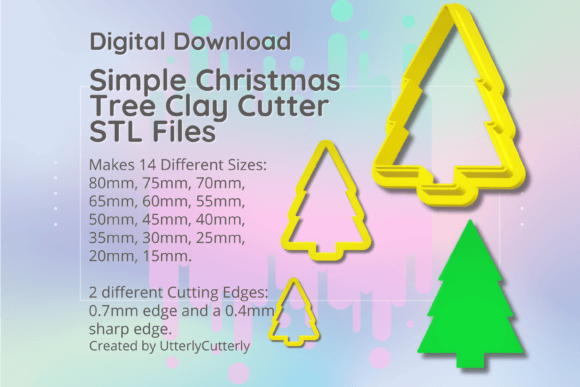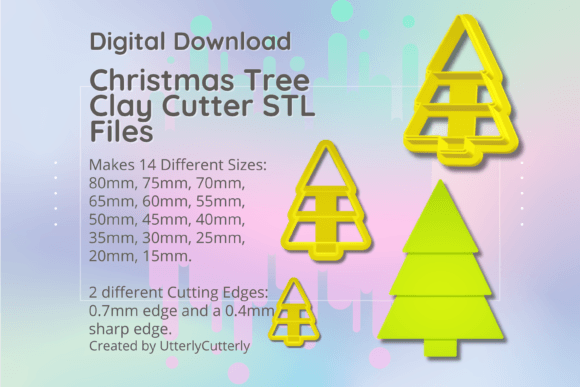
Christmas Tree Clay Cutter STL Digital Download
Creating consistent, professional-grade holiday crafts requires tools that bridge the gap between artistic vision and technical execution. The Christmas Tree Clay Cutter - STL Digital collection provides makers with immediate access to precision-engineered designs optimized for both polymer clay jewelry and festive baking. Rather than relying on generic, mass-produced cutters that often lack detail or durability, this digital bundle allows you to fabricate tools tailored specifically to your project requirements. With fourteen distinct sizes and two specialized cutting edge profiles, this STL package supports a wide spectrum of creative applications, from delicate earring components to substantial cookie decorations.
Versatility Through Precision Sizing
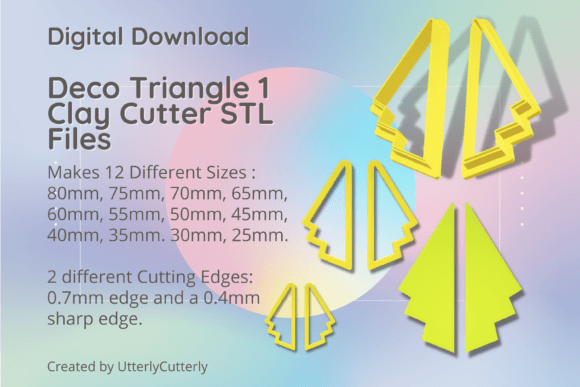
One of the primary challenges in craft production is maintaining visual harmony across different product lines. A single cutter size rarely suffices for a comprehensive holiday collection. This digital download addresses that limitation by offering a graduated sizing system measured from the longest ends of the design. The range includes 80mm, 75mm, 70mm, 65mm, 60mm, 55mm, 50mm, 45mm, 40mm, 35mm, 30mm, 25mm, 20mm, and 15mm options.
This granular size progression enables creators to curate custom combos easily. For jewelry makers, the 15mm to 30mm range is ideal for lightweight earrings and charms, while the 35mm to 50mm sizes work well for pendants and brooches. Bakers and cookie decorators can utilize the larger 55mm to 80mm variants for statement cookies or tiered cake toppers. Having the entire spectrum available as printable files means you can prototype and adjust your product lineup without waiting for shipping or settling for unavailable sizes. This flexibility is particularly valuable for small business owners who need to adapt quickly to customer requests or market trends during the busy holiday season.
Selecting the Right Edge Profile for Your Medium
Not all clay or dough behaves identically, and using the wrong tool geometry can result in torn edges, sticking, or excessive cleanup time. This STL bundle includes two distinct cutter types designed to solve specific material challenges. Understanding the difference between these profiles is essential for achieving clean results.
- Standard 0.7mm Wall: This profile features a 0.7mm wall thickness with a 3mm thick base and a total height of 12mm. It offers a balance of rigidity and cutting efficiency suitable for general-purpose use. The thicker wall provides structural integrity, making it less prone to warping during printing or flexing during use. This version is excellent for softer polymer clays, fondant, and standard cookie doughs where extreme sharpness is less critical than tool longevity.
- Sharp Edge (SE): Abbreviated as SE in the file names, this variant is engineered for precision. It utilizes a 1mm support wall tapering to a 0.4mm cutting edge, maintaining the same 3mm base and 12mm height. Crucially, it includes a 10.5mm embossing wall, making it effective for clay depths thicker than 1.5mm. The finer edge slices cleanly through firmer materials and detailed textures without dragging. This is the preferred choice for intricate jewelry work, leather clay, or any application where crisp definition is paramount.
By providing both options, the digital file ensures you are not forced to compromise. You might use the SE version for high-detail porcelain clay earrings while reserving the standard 0.7mm version for quick-production gingerbread cookies. This material-specific adaptability reduces waste and improves the overall finish of your work.
Optimizing Print Settings for Functional Tools
Because our cutters are designed to be easily printed, they integrate smoothly into existing maker workflows. However, achieving the intended performance requires appropriate slicer settings. The 3mm thick base is designed to provide a comfortable grip and prevent the cutter from digging into your fingers during use, but it also serves a functional purpose in print adhesion. When slicing these files, ensure adequate brims or rafts if your bed adhesion is inconsistent, though the wide base typically mitigates this issue.
For the Sharp Edge (SE) files, pay close attention to layer height and extrusion width. A 0.4mm nozzle is generally recommended to accurately reproduce the fine cutting tip. Printing at lower layer heights (0.12mm to 0.16mm) can improve the smoothness of the embossing wall, which directly translates to cleaner impressions in your clay. All our cutters are tested before being sold as part of our standard quality assurance process, meaning the geometry has been validated for printability. Nevertheless, users should always run a test print to calibrate flow rates and retraction settings specific to their filament type, as PLA, PETG, and ABS all behave differently when forming thin walls.
Streamlining Production for Makers and Educators
For educators teaching ceramics or jewelry design, having instant access to scalable tools simplifies lesson planning. Instead of purchasing expensive physical sets that may break or go missing, instructors can print fresh cutters for each class session. The ability to select specific sizes allows for differentiated instruction; beginners might start with larger, more forgiving sizes while advanced students tackle smaller, more detailed projects using the SE profile.
Small business owners benefit similarly from the digital format. During peak holiday demand, the ability to replace a broken cutter in minutes rather than days prevents production bottlenecks. Furthermore, because new STL files come to our store every week, creators can continuously expand their offerings without significant capital investment. This model supports sustainable scaling, where tool acquisition costs align directly with revenue generation rather than speculative inventory stocking.
Important Considerations for Digital Assets
It is important to note that this is not a physical item. You will have access to download the files after payment, requiring a functional 3D printer and basic slicing knowledge. While the designs are optimized for ease of printing, users without access to fabrication equipment should seek local maker spaces or printing services. Additionally, while the 10.5mm embossing wall on the SE version accommodates clay depths thicker than 1.5mm, extremely thick slabs may still require conditioning or partial rolling to ensure the cutter penetrates fully without distortion.
Food safety is another consideration for bakers. While PLA is generally considered food-safe in its pure form, 3D printed objects have layer lines that can harbor bacteria. For cookie cutting, we recommend using the printed tools exclusively for dough that will be baked at sufficient temperatures, or sealing the cutters with a food-safe epoxy coating. For polymer clay and non-food crafts, no additional treatment is necessary beyond standard cleaning.
The Christmas Tree Clay Cutter - STL Digital bundle represents a practical solution for modern makers who value autonomy and precision. By combining extensive size variety with specialized edge geometries, it removes common friction points in handmade production. Whether you are refining a jewelry line, preparing for a holiday market, or teaching a workshop, these digital files provide the reliable foundation needed to execute your creative vision efficiently. The immediate availability and tested design quality ensure that your focus remains on creation rather than tool troubleshooting.