Arch 24 Clay Cutter: Evaluating the Basic Shape STL Digital Download
For makers and small business owners utilizing 3D printing for polymer clay or cookie production, the quality of digital assets is just as critical as the hardware itself. The Arch 24 Clay Cutter - Basic Shape STL Di represents a functional approach to digital fabrication tools, offering a comprehensive bundle designed specifically for ease of printing and practical application. Unlike generic shape files that often require extensive post-processing or fail during the print cycle, this digital download focuses on technical specifications that align with the realities of FDM printing and clay manipulation. Understanding the specific engineering behind these STL files helps determine their value within a professional or serious hobbyist workflow.
Technical Specifications and Printability
The primary advantage of acquiring specialized STL files like the Arch 24 bundle lies in the pre-tested geometry. When evaluating digital cutter files, wall thickness and base stability are the most common failure points. This pack addresses those concerns by providing two distinct cutter types optimized for different end-uses. Both variations share a 3mm thick base and a 12mm height, which provides sufficient rigidity to prevent warping during printing while maintaining enough surface area for comfortable handling during use.
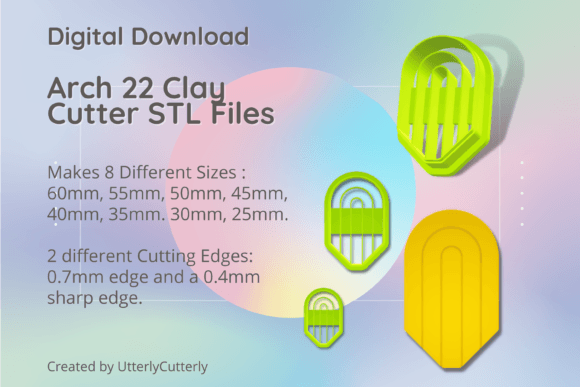
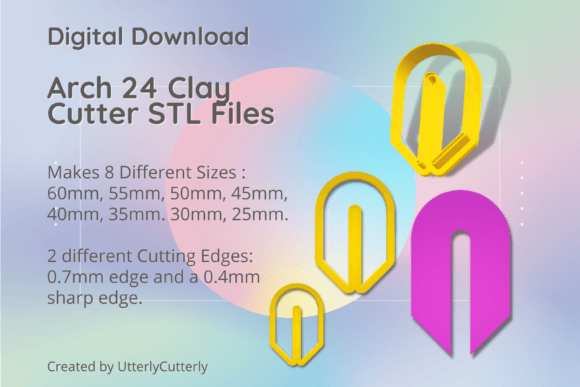
The first variation features a 0.7mm wall with a matching 0.7mm cutting edge. This specification is generally more forgiving for printers with standard 0.4mm nozzles, as it allows for two perimeters on the cutting wall. This results in a durable tool suitable for firmer clays or repetitive use where edge longevity is prioritized over extreme sharpness. The second variation, abbreviated as SE (Sharp Edge) in the file naming convention, utilizes a 1mm support wall tapering to a 0.4mm cutting edge. This design requires precise calibration but yields a significantly cleaner cut in soft polymer clays, reducing drag and deformation. Having both options in a single digital download allows users to select the appropriate tool based on their specific printer capabilities and material hardness.
Sizing Logic and Workflow Integration
Versatility in design work often depends on having incremental size options rather than isolated shapes. The Arch 24 Clay Cutter bundle includes eight distinct sizes measured from the longest ends: 60mm, 55mm, 50mm, 45mm, 40mm, 35mm, 30mm, and 25mm. This 5mm graduation is practically significant for creators who need to produce nested designs, graduated sets, or consistent product lines. For jewelry makers, the smaller increments allow for precise scaling of earring components, while the larger sizes accommodate pendant bases or cookie decorations without requiring manual resizing in CAD software, which can sometimes distort aspect ratios.
Furthermore, the interoperability of these files enhances their long-term value. Because they adhere to a consistent sizing logic, they can be easily combined with other STL files from the same ecosystem. Curating custom cutter combos becomes a matter of mixing and matching standardized sizes rather than attempting to force incompatible geometries together. For professionals managing a catalog of products, this consistency reduces decision fatigue and streamlines the prototyping phase.
Practical Application and Material Considerations
While the cutting edges are the focal point, functional details regarding embossing distinguish high-quality STL files from basic outlines. If the Arch 24 design includes embossing lines, they are set at 10.5mm tall. This specific dimension is not arbitrary; it dictates material preparation. Users must condition their clay to a thickness greater than 1.5mm to fully engage the embossing feature without bottoming out. This technical constraint serves as a useful guideline for workflow preparation, ensuring that the physical material matches the digital intent before printing begins.
In real-world use, the 12mm overall height of these cutters strikes a balance between ergonomics and print efficiency. Taller cutters consume more filament and time but offer better grip and leverage when pressing into dense materials. Conversely, shorter cutters save resources but can be difficult to handle. The 12mm standard used here is widely regarded as the optimal midpoint for hand-held clay tools. Additionally, the 3mm base thickness ensures that the cutter remains flat on the build plate during printing, minimizing the risk of elephant’s foot or first-layer adhesion issues that frequently plague thinner-walled models.
Evaluating Value for Different User Segments
The utility of the Arch 24 Clay Cutter - Basic Shape STL Di varies depending on the user's operational context. For small business owners producing polymer clay jewelry, the ability to print replacement cutters on demand eliminates supply chain dependencies. Physical metal cutters are expensive and limited in availability; digital files provide infinite reproducibility at the cost of filament. The inclusion of both standard and sharp edge profiles allows businesses to maintain quality standards across different product lines without purchasing multiple physical toolsets.
Educators and workshop leaders may find particular value in the "easily printed" nature of these files. In classroom or maker-space environments where printer tuning may vary, having robust default geometries increases the success rate for students learning to fabricate their own tools. The clear differentiation between file types also serves as an excellent teaching aid for understanding the relationship between digital design parameters and physical performance.
However, prospective users should realistically assess their equipment before acquisition. The Sharp Edge (SE) variant, with its 0.4mm tip, demands a well-calibrated machine. Users with worn nozzles, inconsistent extrusion, or poor cooling may struggle to achieve clean prints with the SE files, making the standard 0.7mm version their only viable option. Recognizing this limitation upfront prevents frustration and ensures the digital asset delivers its promised value.
Digital Asset Management and Long-Term Usability
As a purely digital product, the Arch 24 bundle requires users to manage file organization effectively. Since new STL files are added to the store weekly, maintaining a structured library becomes essential for maximizing the investment. Professionals should consider implementing a naming convention that mirrors the file abbreviations (such as SE for Sharp Edge) to quickly identify appropriate tools during active projects. The immediate access model post-payment supports agile workflows, allowing creators to respond to trends or client requests without waiting for shipping.
The testing protocol mentioned for these cutters adds a layer of reliability often missing from open-source repositories. While free STL sites offer volume, they rarely guarantee printability or functional efficacy. Paid, tested assets like Arch 24 reduce the trial-and-error tax that consumes valuable production time. For users whose time has a tangible monetary value, the premium for verified geometry is typically offset by the reduction in failed prints and wasted material.
Ultimately, the Arch 24 Clay Cutter - Basic Shape STL Di functions as a foundational digital tool rather than a novelty. Its strength lies in its adherence to manufacturing constraints and user needs rather than aesthetic complexity alone. By providing dual edge profiles, logical sizing increments, and embossing-compatible dimensions, it supports a professional-grade workflow for clay artists and bakers alike. Success with this asset depends less on the file itself and more on the user’s willingness to match their printer settings and material preparation to the provided specifications. When those variables align, the result is a reliable, scalable system for creating custom cutting tools that supports both creative exploration and commercial production.