1920s Wing 1 Clay Cutter: Art Deco STL Files
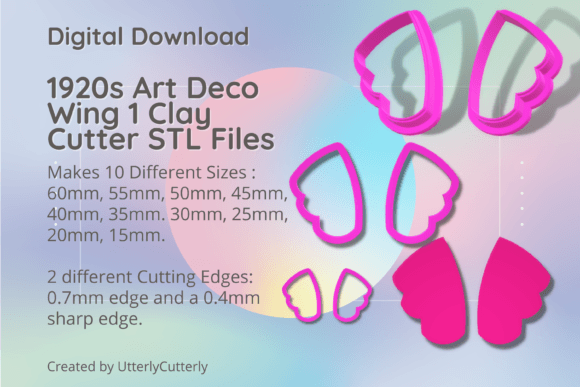
The geometric elegance of the Roaring Twenties continues to inspire modern makers, and the 1920s Wing 1 Clay Cutter - Art Deco Shape captures this timeless aesthetic in a functional digital format. This bundle offers high-resolution STL files designed specifically for polymer clay artists, cookie decorators, and jewelry creators who own 3D printers. Rather than purchasing a single physical tool, you receive a versatile digital download containing ten distinct sizes and two specialized cutting edge profiles. This approach allows for immediate access and unlimited reproduction, making it an essential resource for those looking to integrate vintage glamour into contemporary projects.
Understanding the Design and Technical Specifications
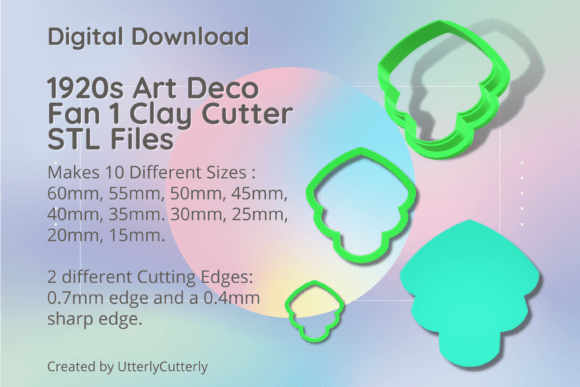
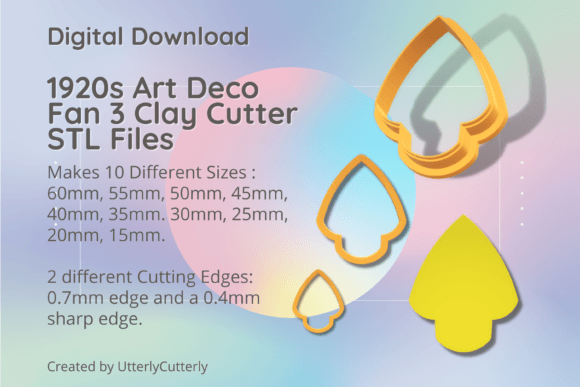
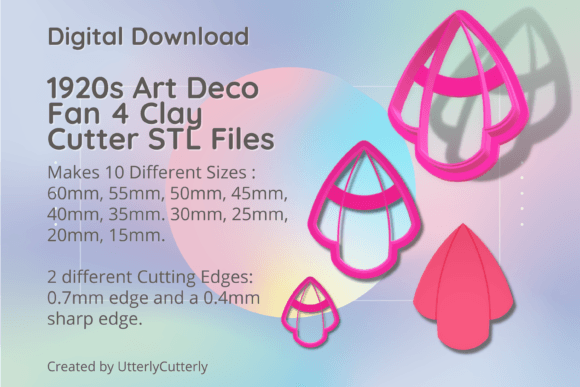
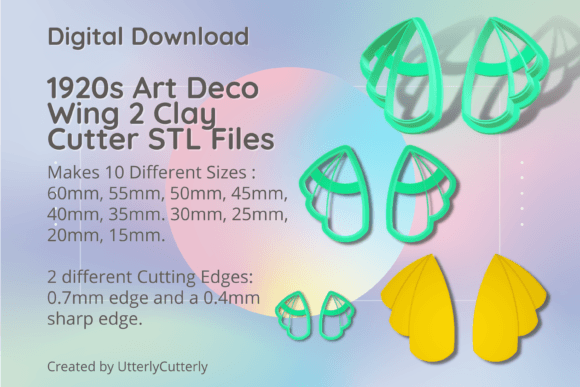
This digital pack is engineered for precision and ease of printing. The "Wing 1" design features the streamlined, symmetrical lines characteristic of Art Deco architecture and fashion. When evaluating this file set, it is helpful to understand that cutter size is measured from the longest ends, ensuring accurate scaling for your specific project needs. The bundle includes a graduated range of sizes: 60mm, 55mm, 50mm, 45mm, 40mm, 35mm, 30mm, 25mm, 20mm, and 15mm. This variety eliminates the need to manually resize models in slicing software, which can sometimes distort delicate wall thicknesses.
Crucially, the download provides two distinct cutter types to suit different materials and finishing preferences:
- Standard Edge: Features a 0.7mm wall with a 3mm thick base and a total height of 12mm. This robust profile is ideal for general-purpose cutting and offers durability during repeated use.
- Sharp Edge (SE): Abbreviated as SE in the file names, this version includes a 1mm support wall leading to a fine 0.4mm cutting edge. It shares the same 3mm base and 12mm height but is optimized for cleaner cuts with minimal material displacement.
For users interested in textured work, any embossing lines within the design are set at 10.5mm tall. This specific depth requires clay to be conditioned to at least 1.5mm thick to capture the detail effectively without tearing.
Relevance for Jewelry Makers and Polymer Clay Artists
For artisans focused on wearable art, the smaller sizes in this bundle (15mm through 30mm) are particularly valuable. Creating consistent earring pairs or charm sets often requires exact duplication that hand-cutting cannot achieve. The Sharp Edge (SE) variant is frequently preferred in this context because the 0.4mm blade slices through polymer clay with less resistance, reducing the risk of dragging or distorting soft metallic clays like mica-shifted blends.
Jewelry designers also benefit from the digital nature of this product. If a specific design becomes popular, you can print replacement cutters instantly rather than waiting for shipping. The 12mm height provides ample surface area for gripping, which is a significant ergonomic consideration when producing small batches of intricate components. Furthermore, having ten sizes allows for the creation of tiered designs, such as stacked wing pendants or graduated drop earrings, using a cohesive visual language across the entire collection.
Applications for Bakers and Cookie Decorators
While originally envisioned for clay, Art Deco shapes have seen a resurgence in culinary arts, particularly for themed events like Great Gatsby parties or vintage weddings. For bakers, the larger sizes (40mm to 60mm) serve as excellent fondant or dough cutters. The Standard Edge with its 0.7mm wall is generally more suitable for food-safe applications when printed in appropriate materials, as the thicker wall is easier to clean and less likely to harbor residue compared to ultra-thin blades.
Bakers should note that the 12mm height is sufficient for most rolled fondants and sugar cookies. However, because this is a digital file, food safety depends entirely on your printer setup and post-processing. Many professional decorators use these STL files to create master molds in silicone rather than using the printed plastic directly on food. This workflow leverages the precision of the 3D print while ensuring the final tool meets health standards. The geometric symmetry of the Wing 1 shape also translates beautifully to royal icing flooding, where defined boundaries are essential for crisp lines.
Educational Value and Skill Development
Educators and workshop leaders may find this bundle useful as a teaching aid. The inclusion of two different edge profiles provides a practical opportunity to discuss tool geometry and material interaction. Students can test both the Standard and Sharp Edge cutters on the same clay body to observe how wall thickness affects drag, edge definition, and cleanup time. This hands-on comparison builds critical problem-solving skills that transfer to other aspects of making.
Additionally, the graduated sizing supports lessons on scale and proportion. Beginners often struggle to visualize how a design changes when resized. Having pre-calculated, distortion-free sizes allows students to focus on composition and technique rather than technical troubleshooting. For educators running makerspaces or art classes, the ability to print replacements means the learning environment remains resilient against breakage or loss, keeping costs predictable over the long term.
Considerations for Small Business Owners
For entrepreneurs selling finished goods, the 1920s Wing 1 Clay Cutter - Art Deco Shape represents a balance of uniqueness and efficiency. Custom tools are often a barrier to entry for new businesses due to minimum order quantities and lead times. Digital downloads remove these friction points, allowing for rapid prototyping of new product lines. You can test market response to Art Deco aesthetics with minimal upfront investment before committing to larger production runs.
The versatility of the size range also supports product diversification. A single design asset can yield keychains, brooches, cake toppers, and gift tags simply by selecting a different STL file from the pack. This maximizes the return on each design acquisition. Moreover, because new STL files are added to the store weekly, business owners can curate custom cutter combos that align with seasonal trends or client requests, maintaining a fresh inventory without holding physical stock.
Making the Right Choice for Your Workflow
Determining whether this digital bundle fits your needs involves assessing your current equipment and project goals. Since this is not a physical item, access is contingent upon having a functioning 3D printer and basic slicing knowledge. If you lack printing capabilities, you may need to factor in the cost of a printing service or consider physical alternatives.
However, for those with printing access, the value proposition is significant. The dual-edge options cater to both rough shaping and fine detailing, reducing the need for multiple specialized purchases. Whether you are a hobbyist exploring 1920s revival styles, a professional seeking consistent production tools, or an educator demonstrating manufacturing concepts, the technical specifications and size variety offer practical utility. Always verify that your chosen filament and printer settings align with the intended use, especially regarding food contact or fine-detail resolution, to ensure the best results from your digital download.