Split 6 Petal Flower Clay Cutter STL Guide
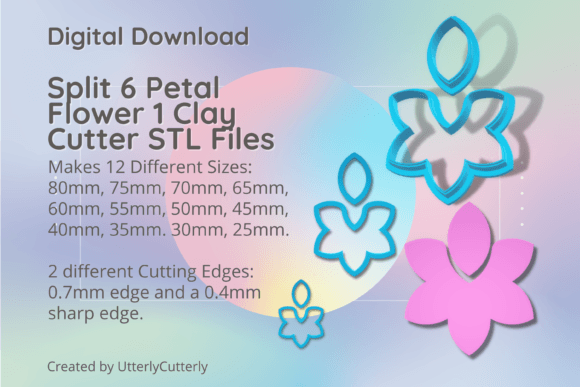
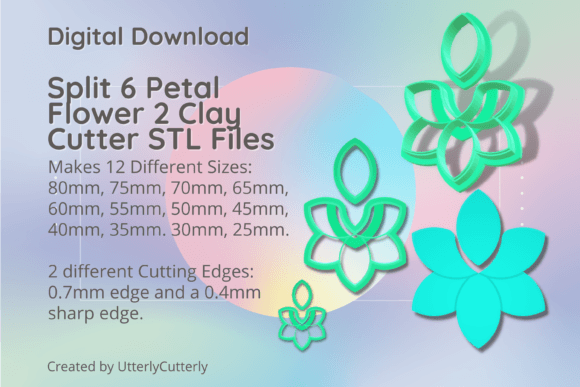
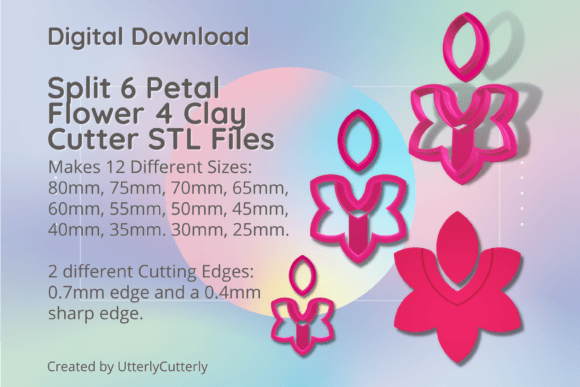
Achieving consistent, intricate floral designs in polymer clay or cookie dough often requires specialized tools that balance precision with durability. The Split 6 Petal Flower 3 Clay Cutter STL provides a digital solution for creators who own 3D printers and require reliable, repeatable shapes for their work. Rather than relying on generic cutters that may lack detail or structural integrity, this digital download offers a comprehensive bundle designed specifically for the nuances of additive manufacturing. By utilizing these optimized files, makers can produce professional-grade tools tailored to specific project requirements, ranging from delicate jewelry components to larger decorative elements.
Optimizing Print Settings for Dual Edge Profiles
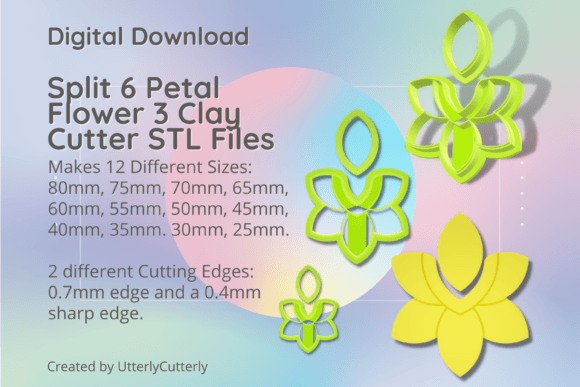
One of the primary advantages of this STL pack is the inclusion of two distinct cutting edge profiles, each serving a different functional purpose. Understanding when to use each type is essential for maximizing the utility of the Split 6 Petal Flower 3 Clay Cutter STL. The first option features a 0.7mm wall thickness with a 3mm thick base and a 12mm height. This robust profile is ideal for general-purpose cutting where rigidity is paramount. It withstands higher pressure during use and is less prone to warping during the printing process, making it a practical choice for beginners or for cutting denser materials like shortbread cookie dough.
The second option, abbreviated as SE (Sharp Edge) in the file names, utilizes a 1mm support wall tapering to a precise 0.4mm cutting edge. While maintaining the same 3mm base and 12mm height for handling comfort, this geometry slices through polymer clay with significantly less resistance. This reduced friction helps prevent distortion in soft clays and produces cleaner edges that require minimal post-processing. However, the sharper profile demands careful print orientation and adequate cooling to ensure the fine edge forms correctly without drooping. Users should select the SE variant for detailed jewelry work and the standard 0.7mm variant for high-volume production or tougher mediums.
Navigating Size Variations for Design Hierarchy
Versatility in design often stems from having access to graduated sizing. This bundle includes twelve distinct sizes measured from the longest ends: 80mm, 75mm, 70mm, 65mm, 60mm, 55mm, 50mm, 45mm, 40mm, 35mm, 30mm, and 25mm. Having this full spectrum available digitally allows creators to establish visual hierarchy within a single collection without sourcing multiple physical products. For example, a jewelry maker might use the 25mm and 30mm cutters for earring charms while utilizing the 60mm version for a matching pendant. Cookie decorators can create tiered floral arrangements by layering progressively smaller cuts.
This size range also supports efficient material usage. When working with expensive metallic clays or limited-batch doughs, being able to select the exact cutter size needed reduces waste. The incremental 5mm steps between sizes provide enough variation to be visually distinct while remaining close enough to allow for seamless nesting or stacking in compositions. Because these are digital files, you can print only the specific sizes required for a current project, storing the rest digitally until needed.
Technical Considerations for Embossing and Depth
For users intending to utilize the embossing features included in some variations of the Split 6 Petal Flower 3 Clay Cutter STL, understanding depth tolerances is critical. Any embossing lines in these files are set to a height of 10.5mm. Given the total cutter height of 12mm, this leaves a 1.5mm clearance at the top. Consequently, these embossing details will only register effectively on clay rolled thicker than 1.5mm. Attempting to use these cutters on thinner sheets will result in incomplete impressions or potential tearing of the material.
This specification highlights the importance of using pasta machines or rolling guides set to appropriate thicknesses before cutting. If your workflow typically involves very thin veneers under 1mm, the embossing function may not be suitable, and the flat cutting versions would be preferable. Conversely, for textured surface techniques where depth adds tactile value, ensuring your clay slab exceeds the 1.5mm threshold guarantees crisp, well-defined patterns. Always test a small sample piece when introducing a new cutter size to verify that the embossing depth aligns with your specific clay body and conditioning state.
Streamlining Workflow Through Digital Inventory
Maintaining a physical inventory of dozens of cutter sizes consumes valuable studio space and capital. Transitioning to a digital-first approach with STL files transforms how small business owners and hobbyists manage their toolsets. With the Split 6 Petal Flower 3 Clay Cutter STL, the entire 12-size bundle occupies negligible digital storage yet offers immediate production capability. This model supports just-in-time manufacturing; if a custom order requires a specific 45mm floral element, the tool can be printed on demand rather than sourced from a supplier with uncertain lead times.
Furthermore, digital files facilitate easy replacement and iteration. Physical plastic cutters eventually degrade, lose sharpness, or break. With an STL library, replacing a worn tool costs only filament and electricity. This sustainability aspect appeals to eco-conscious creators who wish to minimize plastic waste. Additionally, because new designs are added to the store weekly, maintaining a digital library allows for rapid integration of trending shapes into existing product lines without significant upfront investment.
Best Practices for Printing and Material Compatibility
While these cutters are designed to be easily printed, achieving optimal results requires attention to slicer settings. Food-safe considerations are particularly relevant for those using the Split 6 Petal Flower 3 Clay Cutter STL for cookies. Standard FDM printing creates layer lines that can harbor bacteria. If using these for food preparation, it is advisable to coat the finished print with a food-safe epoxy resin or use them exclusively with fondant and modeling chocolate rather than direct dough contact. For polymer clay applications, standard PLA or PETG filaments are generally sufficient, though PETG offers better heat resistance if baking clay directly against the cutter.
Bed adhesion is crucial given the relatively small footprint of the smaller sizes (25mm-35mm). Using a brim or raft for the smaller cutters can prevent detachment during printing. For the Sharp Edge variants, reducing print speed on outer walls and increasing part cooling fan speed helps maintain the integrity of the 0.4mm tip. Post-processing may involve light sanding of the base to ensure it sits perfectly flat on your work surface, preventing uneven cuts. Regular calibration of your printer’s flow rate ensures the 0.7mm walls remain consistent and do not become too brittle or too thick.
Integrating Cutters Into Broader Creative Systems
The true value of this bundle emerges when combined with other compatible STL files. The standardized sizing and design language allow for modular creativity. Creators can curate unique combo packs by mixing the split six-petal flower with complementary leaf, stem, or center detail cutters from the same ecosystem. This interoperability simplifies decision-making during the design phase, as users can trust that components will scale proportionally together.
Educators and workshop leaders also benefit from this system. Providing students with identical, precisely sized cutters eliminates variables related to tool quality, allowing instruction to focus on technique. Since the files are digital, instructors can distribute them instantly to remote learners or print sets locally for in-person classes. This scalability makes the Split 6 Petal Flower 3 Clay Cutter STL a practical asset for both individual artisans and those teaching creative skills. Remember, this is strictly a digital product; access to the files is granted immediately upon payment, enabling instant commencement of projects without shipping delays. All designs undergo testing to verify printability and cutting performance, providing confidence that the digital assets will translate reliably into physical tools.