Mastering Polymer Clay and Cookie Design with the Arch 35 Clay Cutter STL Bundle
In the evolving world of digital fabrication and handmade crafts, the intersection of 3D printing technology and artisanal creativity has opened up unprecedented possibilities for makers. Whether you are a professional jeweler, a polymer clay enthusiast, or a baker looking to elevate your cookie decorations, the tools you use define the quality of your output. The Arch 35 Clay Cutter - STL Digital File D represents a significant leap forward in this space, offering a versatile, digitally downloadable solution that puts manufacturing power directly into your hands. This comprehensive bundle is not merely a set of shapes; it is a curated system designed for precision, ease of printing, and endless creative adaptation.
Understanding Digital Craft Tools: The Shift to STL Files
To fully appreciate the value of this arch shape clay cutter bundle, one must first understand the shift from traditional manufacturing to digital downloads. Historically, acquiring specialized cutters meant waiting for shipping, dealing with limited stock, or settling for generic sizes that didn't quite fit a specific project vision. By choosing an STL digital file, you bypass these logistical hurdles entirely. STL (Standard Tessellation Language) files are the universal language of 3D printing, containing the geometric data necessary for your printer to construct a physical object layer by layer.
This digital-first approach aligns perfectly with modern maker culture. It allows for immediate access; once payment is processed, the files are available for instant download. There is no physical item shipped to your door. Instead, you receive the blueprint for creation. This model supports sustainability by reducing shipping emissions and packaging waste, while simultaneously empowering users to produce exactly what they need, when they need it. For businesses and hobbyists alike, this means reduced overhead costs and the ability to iterate on designs rapidly without waiting for external suppliers.
Technical Specifications: Why Wall Thickness Matters
Not all 3D printed cutters are created equal. A common misunderstanding among beginners is assuming that any STL file will yield a functional tool. In reality, cutter design requires specific engineering considerations to balance sharpness with structural integrity. The Arch 35 bundle addresses this by providing two distinct cutting edge variations within the same pack, ensuring versatility across different materials.
The Standard Edge vs. The Sharp Edge (SE)
The bundle includes files for two specific cutter types, each engineered for different applications:
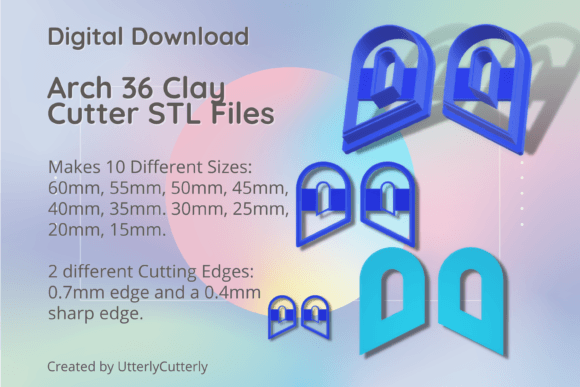
- Standard Edge: This variation features a 0.7mm wall thickness with a 3mm thick base and a total height of 12mm. The slightly thicker wall provides rigidity, making it ideal for firmer clays or doughs where lateral pressure might cause thinner walls to flex. The 3mm base ensures comfort during use, preventing finger fatigue during long production sessions.
- Sharp Edge (SE): Abbreviated as "SE" in the file names, this version boasts a cutting edge of just 0.4mm supported by a 1mm support wall. Like the standard version, it maintains a 3mm thick base and 12mm height. This ultra-fine edge is designed for clean, precise cuts in softer polymer clays or fondant, minimizing drag and deformation. The 1mm support wall is the minimum viable thickness for most FDM printers to maintain accuracy while achieving a blade-like profile.
Both variations share a consistent 12mm height, which is a critical dimension. This height accommodates embossing lines that stand 10.5mm tall. Understanding this relationship is vital: if you plan to utilize the embossing features, your clay or dough must be thicker than 1.5mm to allow the material to flow into the recesses without bottoming out prematurely. This technical foresight in the design phase prevents the frustration of failed impressions and wasted material.
Sizing Strategy: Curating Custom Combinations
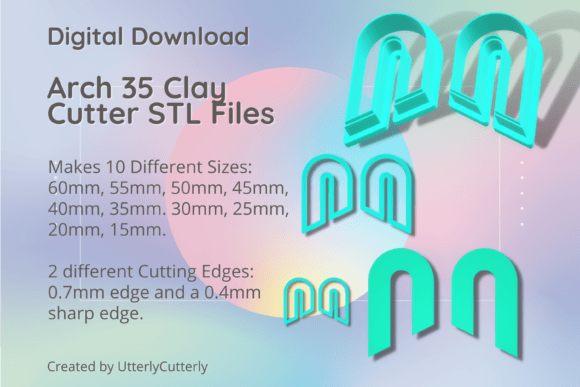
Versatility in design often comes down to scale. A single arch shape can serve as a statement earring at 60mm or a delicate charm at 15mm. The Arch 35 bundle recognizes this need for scalability by including ten distinct sizes. This graduated sizing system allows creators to build cohesive collections rather than isolated pieces.
The included sizes are measured from the longest ends of the arch, providing a predictable metric for planning:
- 60mm
- 55mm
- 50mm
- 45mm
- 40mm
- 35mm
- 30mm
- 25mm
- 20mm
- 15mm
Having this full spectrum available in a single digital pack enables you to curate custom combos easily. For example, a jewelry maker might use the 60mm and 55mm sizes for bold necklaces, the 35mm and 30mm sizes for standard earrings, and the 15mm size for matching stud accents. Because these files are designed to integrate seamlessly with other STL files in our store, you can mix this arch shape with textures, additional geometric forms, or seasonal motifs to create unique product lines that stand out in a saturated market.
Optimizing Your 3D Printing Workflow
While these cutters are designed to be easily printed, achieving professional results requires attention to your printer settings. Since this is a digital download, the final quality depends heavily on your hardware and slicing parameters. Here are practical insights for getting the best results from your Arch 35 STL files:
- Nozzle Selection: For the Sharp Edge (SE) files with 0.4mm cutting edges, a 0.4mm nozzle is generally sufficient. However, if you have access to a 0.2mm nozzle, you will achieve superior definition on the cutting tip and smoother surface finishes on the 1mm support walls.
- Material Choice: Food-safe PLA is recommended for cookie cutters, provided they are washed by hand and not exposed to high heat. For polymer clay, standard PLA, PETG, or resin are all excellent choices. Resin prints, in particular, offer exceptional detail for the SE variants but require proper post-curing and safety precautions.
- Orientation and Supports: These cutters are designed to be printed vertically (standing on the base). This orientation places the layer lines horizontally along the cutting edge, which can sometimes leave ridges. Some makers prefer printing them upside down with supports to get a perfectly smooth cutting face, though this requires post-processing to remove support marks. Experiment with both methods to see which suits your finish requirements.
- Brim Usage: Given the relatively small footprint of the 15mm and 20mm cutters, using a brim is highly advisable to prevent warping or detachment from the build plate during the initial layers.
Creative Applications Beyond the Basics
The utility of the Arch 35 Clay Cutter extends far beyond simple outline cutting. In modern craft education and business, understanding how to leverage multi-functional tools is key to efficiency. The embossing capability integrated into these designs transforms them from mere outline tools into texturing instruments. This dual functionality saves time; instead of cutting a shape and then manually stamping a texture, you accomplish both steps in a single motion.
For educators teaching ceramics or jewelry design, these digital files serve as excellent case studies in functional design. Students can analyze why the base is 3mm thick (ergonomics), why the embossing is 10.5mm tall (material displacement physics), and how digital files democratize access to professional-grade tooling. In a business context, the ability to print replacement cutters instantly means zero downtime. If a cutter breaks during a rush order, you simply print another one. This resilience is invaluable for small businesses operating on tight deadlines.
Ensuring Quality and Safety
A frequent concern with digital downloads is consistency. Unlike mass-produced injection-molded tools, every 3D print is unique to the machine that made it. To address this, all our cutters are tested before being sold as part of our digital catalog. This testing verifies that the wall thicknesses are printable on standard consumer machines and that the dimensions are accurate to the specifications listed.
However, users should always perform their own validation. Print a test cutter in the smallest size first to calibrate your flow rate and ensure the 0.4mm or 0.7mm walls are fusing correctly without gaps. For food-related applications, always adhere to local regulations regarding 3D printed items. Layer lines can harbor bacteria, so many professionals use 3D printed cutters only for shaping, followed by baking or sealing processes that ensure food safety, or they coat the finished print in a food-safe epoxy.
Embracing the Future of Maker Tools
The Arch 35 Clay Cutter STL Digital File D bundle exemplifies the modern approach to creative tools: accessible, adaptable, and technically refined. By providing ten sizes and two edge profiles, it respects the diverse needs of the maker community, from the novice experimenting with their first bag of clay to the established artisan fulfilling wholesale orders. As new STL files are added to our store every week, this ecosystem continues to grow, offering endless opportunities for cross-compatibility and collection building.
Ultimately, investing in high-quality digital cutter files is an investment in your creative autonomy. You are no longer limited by what is available on a shelf; you are empowered to manufacture the exact tools your vision demands. Whether you are creating beautiful jewelry or intricate cookies, the foundation of great work lies in great tools. With the Arch 35 bundle, that foundation is just a download away, ready to be brought to life through the magic of 3D printing.